
Naval Architecture // Marine Propulsion
Fixed Pitch Propeller (FPP) vs. Controllable Pitch Propeller (CPP): Mechanics, Hydrodynamics, and Ship Handling Differences
A comprehensive engineering and nautical comparison between the two dominant marine propulsion systems: Fixed Pitch Propellers (FPP) and Controllable Pitch Propellers (CPP). Examining structural design, thrust generation, the transverse thrust paradox during astern maneuvers, engine thermal loads, and berth-side safety.
While they share similar external blade profiles, their mechanical design, operational flexibility, engine interaction, and hydrodynamic behavior during maneuvering differ fundamentally. Overlooking these differences during close-quarters navigation can lead to severe incidents—ranging from depleted starting air reserves on FPP vessels to mooring line parting caused by residual thrust on CPP systems. Understanding theoretical hydrodynamics is essential, as detailed in Basic Ship Theory.
1. Fixed Pitch Propeller (FPP): Monolithic Simplicity and Open-Sea Efficiency
A Fixed Pitch Propeller (FPP) is cast as a single solid unit where the blades and central hub form an integral piece. The geometric pitch ($H$) and the pitch-to-diameter ratio ($H/D$) are fixed during manufacturing and cannot be altered during service.
Thrust magnitude and vessel speed are regulated exclusively by altering the propeller shaft rotational speed (RPM). To reverse the thrust from ahead to astern, the main engine itself must be brought to a complete stop and restarted in the opposite direction (on direct-drive reversible 2-stroke diesel engines) or switched via a reversing gearbox.
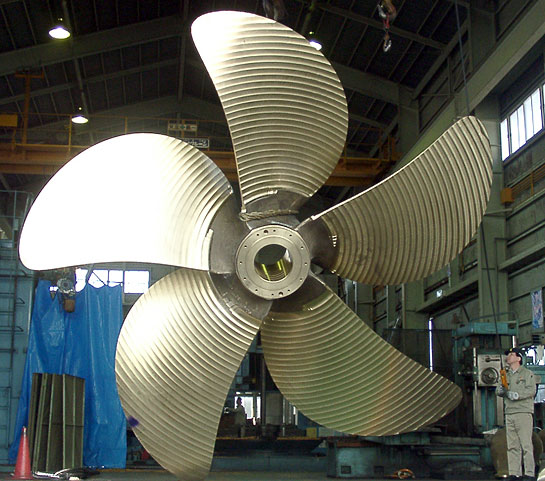
Key Advantages of FPP:
- Maximum Hydrodynamic Efficiency: The monolithic hub maintains a minimal diameter (typically 0.16–0.20 of the overall propeller diameter). This compact root profile produces superior water flow with lower drag, granting a 2–4% higher propulsive efficiency at full sea speed compared to CPP systems.
- Mechanical Simplicity and Reliability: With no moving internal components, linkages, or pressurized hydraulic lines inside the hub, the risk of underwater mechanical failure is essentially eliminated.
- Robust Structural Integrity: Cast from high-grade Nickel-Aluminum Bronze (Ni-Al Bronze), solid blades absorb severe hydrodynamic impacts, cavitation forces, and ice interactions (essential for Polar Class and Baltic ice-class vessels) far better than modular assemblies.
- Lower Capital and Dry-Dock Costs: Manufacturing, installation, survey requirements, and dry-dock overhauls cost significantly less than complex variable-pitch hub mechanisms.
Operational Limitations of FPP:
- Starting Air Limitations: Each engine reversal requires high-pressure starting air (typically 30 bar). While SOLAS and classification societies mandate a minimum of 12 consecutive starts without replenishing air receivers, intense maneuvering in tight channels can deplete air reserves faster than auxiliary compressors can recharge them.
- Maneuvering Latency: Shifting from full ahead to full astern takes time: fuel must be cut, engine RPM allowed to drop below the firing threshold, the camshaft repositioned to astern gear, and starting air injected to spin the shaft backwards.
- Inflexible Shaft-to-Engine Coupling: The propeller turns whenever the engine rotates. Turning the engine for diagnostic tests, indicator cards, or fuel system checks rotates the screw, presenting severe hazards in crowded ports or dry docks.
- Complex PTO Shaft Generator Operation: Variable shaft RPM complicates powering a Power Take-Off (PTO) shaft generator, requiring expensive frequency converters to deliver stable 50/60 Hz power to the shipboard grid.
2. Controllable Pitch Propeller (CPP): Maneuvering Versatility and Constant RPM
A Controllable Pitch Propeller (CPP) features separate blades fastened to rotary trunnions housed inside an enlarged, hollow hub. An internal hydraulic servo cylinder actuates crank pins connected to each blade flange. Hydraulic pressure is supplied through a concentric control rod running inside the hollow tailshaft from an inboard Oil Distribution Box (OD Box).
On CPP vessels, the main diesel engine typically runs at a constant rotational speed (Constant RPM mode), while thrust magnitude and direction are adjusted entirely by rotating the blade pitch. At the “Stop” command, the engine and shaft continue spinning at operational speed, but the blades feather to a neutral angle that produces minimal net axial thrust (Zero Pitch). For astern motion, the blades tilt past neutral into reverse pitch without changing engine rotation.
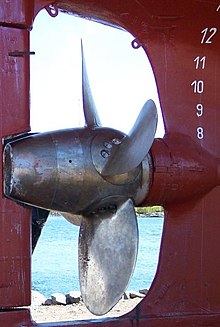
Key Advantages of CPP:
- Unlimited Ahead-Astern Cycles: Reversing thrust from full ahead to full astern takes only 10–20 seconds with a bridge lever adjustment, bypassing air-start cycles and protecting engine cylinders from repeated thermal shock.
- Ultra-Precise Low-Speed Handling: Pitch can be fine-tuned in fractions of a percent, enabling steady control at speeds below 1.0 knot. On FPP vessels, the lowest speed is strictly constrained by the engine’s minimum stable firing RPM (“Dead Slow Ahead”).
- Seamless Shaft Generator Utilization: Constant shaft RPM allows an in-line shaft alternator (PTO) to continuously feed the ship’s main switchboard, bow thrusters, and cargo pumps during transit and pilotage.
- Modular Blade Replacement: Should a single blade suffer damage from debris, ice, or seabed contact, it can be unbolted and replaced independently without pulling the entire tailshaft or replacing the whole propeller.
Operational Hazards and Disadvantages of CPP:
- Mooring Line Entanglement Risk: Because the propeller spins continuously even when stopped, slack synthetic mooring lines or tug messenger ropes drifting near the stern quarter are rapidly snagged. Navigators should train on line handling via the Mooring Operations Simulator.
- Residual “Creep” Thrust: Because propeller blades are hydrodynamically twisted, feathering them to zero pitch at one radius leaves residual positive or negative thrust across other radii. A vessel at “zero pitch” will gradually creep forward or aft unless actively counteracted.
- Hydraulic Complexity and Environmental Risk: Operating at pressures between 60 and 100 bar, seal wear on blade o-rings can cause hydraulic oil leakage directly into sea water, violating environmental regulations.
- Enlarged Hub Drag and Root Cavitation: The hub diameter ratio can exceed 0.30 $D$ to house the actuation mechanisms, resulting in higher parasite drag and localized root cavitation when operating away from design pitch.
On a conventional vessel equipped with a right-hand turning FPP, reversing the engine to astern forces the shaft to rotate to port (counter-clockwise). Transverse thrust (the paddle-wheel effect) vigorously kicks the stern to port (swinging the bow to starboard).
On a vessel with a right-hand turning CPP, reversing the thrust DOES NOT CHANGE SHAFT ROTATION—the shaft continues rotating to starboard! Because the blade faces have inverted their pitch profile, hydrodynamic reaction forces flip: when giving astern thrust, a right-hand CPP kicks the stern to STARBOARD (swinging the bow to port)! Helmspersonnel and watchkeepers should review Helmsman Watch & Steering Orders before handling CPP vessels in close quarters.
3. Technical Comparison: FPP vs. CPP Specifications
The choice of propulsion type directly affects bridge control, fuel economy, engine wear, and maneuvering limits:
| Operational Metric | Fixed Pitch Propeller (FPP) | Controllable Pitch Propeller (CPP) |
|---|---|---|
| Speed Control Method | Variable Engine & Shaft RPM | Variable Blade Pitch Angle ($H$) at Constant RPM |
| Thrust Reversal Method | Stop main engine, start in reverse on air | Hydraulic pitch inversion across neutral (10–20 sec) |
| Open-Water Efficiency | Higher (smaller hub-to-diameter ratio, ~0.18 $D$) | Lower by 2–4% (enlarged hub drag, ~0.30 $D$) |
| Behavior at “Stop” Order | Shaft stationary, zero wake, zero thrust | Shaft spinning; residual creep thrust generated |
| Transverse Thrust (Right-Handed) | Kicks stern to Port on astern propulsion | Kicks stern to Starboard on astern propulsion |
| Mooring Line Hazard | Low when engine is stopped | High: continuous rotation can foul lines instantly |
| Shaft Generator Compatibility | Complex (requires variable-speed drive convertors) | Optimal (constant rotational speed maintains frequency) |
| Typical Fleet Applications | VLCCs, Suezmax tankers, Capesize bulkers, Container ships | Ferries, Ro-Ro vessels, Offshore Support Vessels (OSV), Tugs |
4. Fleet Implementation: Where Each System Excels
Large ocean-going bulk carriers, ore carriers, and crude oil tankers over 50,000 DWT predominantly utilize Fixed Pitch Propellers. For ships covering thousands of open ocean miles at steady passage speeds, saving 2–4% on bunker fuel outweighs dockside agility. At port terminals, these vessels are reliably assisted by harbor tugs under mandatory Marine Pilotage Procedures.
In contrast, passenger vessels, short-sea Ro-Ros, dynamic positioning offshore support vessels (OSVs), cable ships, and harbor escort tugs almost exclusively select Controllable Pitch Propellers. Their operational schedules demand rapid acceleration, zero-speed station keeping, continuous bow thruster power via shaft generators, and quick unassisted berthing.
Understanding these propulsion nuances is vital for the bridge team. Watchkeepers must know when the OOW should call the master during propulsion irregularities, practice emergency steering in the Helmsman Simulator, and review immediate bridge actions during Man Overboard (MOB) maneuvers.