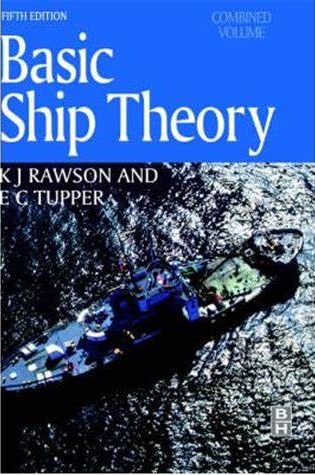
Basic Ship Theory (Volume 1) — K.J. Rawson & E.C. Tupper: Hydrostatics, Stability & Ship Strength
Widely recognized as one of the definitive international standard textbooks on naval architecture and ship design fundamentals. Volume 1 provides a comprehensive and rigorous mathematical foundation in hull geometry, flotation, intact and damaged stability, and longitudinal structural strength calculations.
About the Textbook: Engineering Fundamentals for Mariners and Naval Architects
Authored by distinguished naval architects K.J. Rawson and E.C. Tupper, Basic Ship Theory has served as the core university curriculum across the United Kingdom, Europe, and Asia for decades. The fifth edition thoroughly bridges classical analytical principles with modern commercial practice, delivering clarity without sacrificing mathematical rigor.
For deck officers, marine engineers, and superintendents, Volume 1 provides the underlying theory behind automated shipboard loading instruments (Loadicators) and stability booklets. Understanding these principles enables watchkeepers to critically assess GM margins, free-surface corrections, shear stresses, and hull girder hogging/sagging responses under demanding sea conditions.
- Hull Geometry & Integration: Lines plans, offsets, Simpson’s first and second rules, Tchebycheff rules, and calculation of hull centroids.
- Flotation & Hydrostatics: Displacement, coefficients of form (Cb, Cp, Cw, Cm), wetted surface area, and hydrostatic curves.
- Transverse Stability: Initial metacentric height (GM), metacentric radius (BM), cross curves of stability, and derivation of righting levers (GZ).
- Trim & Longitudinal Stability: Longitudinal center of flotation (LCF), trimming moments, Moment to Change Trim 1 cm (MTC), and draft surveys.
- Flooding & Damage Stability: Added weight versus lost buoyancy methods, compartment permeability, and SOLAS subdivision criteria.
- Longitudinal Hull Strength: Buoyancy and weight curve distribution, Shearing Force (SF) envelopes, and Bending Moment (BM) calculations.