Advanced Ship Squat & UKC Calculator
| Hydrodynamic Factor | Symbol | Calculated Value | Navigational Assessment |
|---|---|---|---|
| Applied Block Coefficient | Cb | 0.820 | Full-form hull (Tanker/Bulker) → Trim by the bow |
| Critical Shallow-Water Wave Speed | Vcr | 24.2 kn | Safe subcritical speed range |
| Froude Depth Number | Fnh | 0.43 | < 0.60 (Linear hydrodynamics zone) |
| Channel Blockage Factor | S (As / Ac) | 0.245 | Moderate fairway restriction |
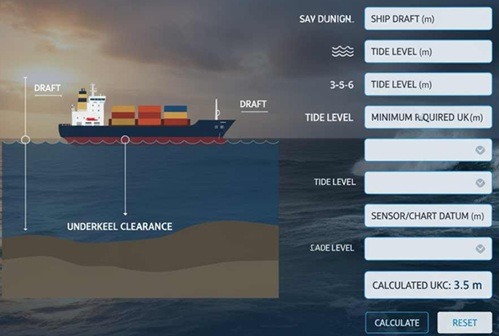
| Static Under Keel Clearance | UKC stat | 2.50 m | At rest condition (H - T) |
| Dynamic Under Keel Clearance | UKC dyn | 1.65 m | 12.2% of static draught (Meets criteria) |
1. Physical Nature of Ship Squat
When a vessel moves through shallow water or a restricted fairway, water displaced by the hull rushes backwards along the sides and underneath the keel at accelerated velocity (return flow). In accordance with Bernoulli's theorem, this velocity increase causes a sharp drop in hydrodynamic pressure beneath the hull, generating a downward suction force and vertical sinkage.
2. Hull Geometry Influence on Trim (Dr. Barrass Trim Rule)
- Cb > 0.72 (Tankers, Bulk Carriers): The center of maximum pressure drop is located forward of amidships. The vessel experiences Bow Squat (trim by the head), drastically reducing clearance under the bulbous bow.
- Cb < 0.68 (Container ships, Ro-Ro, Passenger liners): Due to fine forward waterlines, maximum suction concentrates aft. The vessel experiences Stern Squat (trim by the stern).
- 0.68 ≤ Cb ≤ 0.72: Symmetrical sinkage occurs approximately on an Even Keel.
3. Critical Wave Speed & Froude Depth Number (Fnh)
The velocity of a shallow water gravity wave is defined by Vcr = √(g · H). As vessel speed approaches 0.70 · Vcr (Fnh > 0.65), the ship enters the transcritical speed regime: wave resistance surges exponentially, squat approximately doubles, and severe steering instability can occur. It is strongly recommended to maintain V < 0.60 · Vcr.
4. Recommended UKC Safety Criteria (IMO / PIANC)
- Open Sea / Coastal Waters: Dynamic UKC ≥ 20% of static draught (or minimum 1.5–2.0 m).
- Canals & Port Approaches: Dynamic UKC ≥ 10% of static draught (or minimum 1.0 m).
- IMPORTANT: In the presence of swell or ship rolling/pitching, additional clearance equal to maximum motion amplitude must be added to dynamic draught!
Hydrodynamic Ship Squat & Dynamic Under Keel Clearance (UKC) Estimation
Navigating in confined shallow fairways, canals, and port approaches introduces severe grounding hazards resulting from hydrodynamic sinkage (Ship Squat)[cite: 5, 6]. In compliance with SOLAS Chapter V (Regulation 34), IMO Resolution A.893(21) for Voyage Planning, and the ICS Bridge Procedures Guide, navigating bridge teams and marine pilots must continuously verify depth-to-draft ratios (H/T) and determine dynamic bodily sinkage along each shallow transit leg[cite: 5].
The NavLib Squat & UKC Calculator provides marine professionals with an empirical hydrodynamic computation engine based on validated formulations by Dr. C.B. Barrass and PIANC guidelines (World Association for Waterborne Transport Infrastructure)[cite: 5]. The module computes dynamic bodily sinkage, longitudinal trim tendencies (Bow vs. Stern Squat), shallow-water critical wave speed (Vcr), and net dynamic under keel clearance margins[cite: 5].
Frequently Asked Questions: Ship Squat & UKC (FAQ)
Should Speed Through Water (STW) or Speed Over Ground (SOG) be used for calculating squat?
How does the hull block coefficient (Cb) govern dynamic trim tendencies?
- Cb > 0.72 (Tankers, Bulk Carriers): full forward lines concentrate hydrodynamic suction in the forward third. The vessel trims by the bow (Bow Squat).
- Cb < 0.68 (Container Ships, Passenger Liners): fine forward lines allow smooth water displacement, while run lines accelerate flow aft. The vessel trims by the stern (Stern Squat).
- 0.68 ≤ Cb ≤ 0.72: bodily sinkage occurs nearly parallel to the baseline (Even Keel).
What is critical shallow-water wave speed (Vcr) and the trans-critical regime?
Vcr = square_root(g * H), where g = 9.81 m/s² and H is water depth in meters. The depth Froude number is Fnh = V / square_root(g * H). If vessel speed exceeds 0.65–0.70 * Vcr (Fnh > 0.60), the ship enters the trans-critical zone: wave drag escalates dramatically, stern sinkage deepens abruptly, and steering control degrades. Safe seamanship mandates keeping transit speed well below 0.60 * Vcr.
What are the standard industry benchmarks for safe Under Keel Clearance (UKC)?
- Open Sea and Coastal Waters: dynamic UKC ≥ 20% of static maximum draft;
- Approach Channels, Canals, and Fairways: dynamic UKC ≥ 10% of static draft (or minimum 1.0–1.5 meters of clear water);
- Alongside Berth during Cargo Ops: static clearance of not less than 0.3–0.5 meters accounting for low water tides.