
Helmsman Watchkeeping: Standard IMO SMCP Steering Orders & Bridge Seamanship
Taking the wheel as a helmsman is an essential practical competency for deck ratings (Able Seafarer Deck / Ordinary Seaman) and deck cadets under the STCW Code (Section A-II/4). In heavy traffic, narrow fairways, and pilotage waters, vessel safety depends directly on strict adherence to closed-loop communication and prompt rudder execution.
1. Bridge Watch Organization and Transition to Manual Steering
In open waters under steady passage conditions, the vessel is typically guided along its planned track by the automated heading control system (Autopilot). The watch rating acts as a dedicated Lookout, scanning the horizon and reporting sighted vessels, navigational aids, and hazards to the Officer of the Watch (OOW).
However, when approaching shallow waters, pilot boarding stations, congested fairways, or encountering adverse weather, manual control must be established immediately. The conn issues the command:
- Confirm that the helm wheel is centred (Midships) to avoid hydraulic shock loads during changeover.
- Switch the steering selector from AUTO to HAND / MANUAL.
- Perform a small rudder test by putting the helm 3°–5° to each side, observing responsive movement on the rudder angle indicator.
- Read and verbally report the heading on the gyro repeater and magnetic compass: «Steering course 245 degrees by gyro, 248 by magnetic, Sir».
2. Rudder Hydrodynamics, Ship Speed & Monitoring Instruments
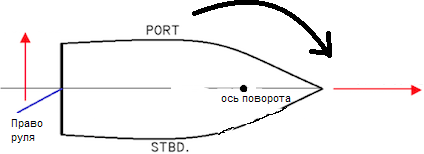 A ship’s rudder functions as a symmetrical foil. Turning force (lift) is generated exclusively by the flow of water across its surface, which is a combination of vessel speed through the water and propeller slipstream velocity.
- At Full Ahead (14–18 knots): The hydrodynamic force is immense. Altering the rudder by merely 10°–15° produces a sharp Rate of Turn (ROT), dynamic heel, and speed reduction. Large rudder angles at sea speed are reserved strictly for critical emergencies (such as a Williamson Turn for Man Overboard recovery).
- At Dead Slow Ahead (3–5 knots): Rudder effectiveness drops substantially. To maintain heading or overcome bank effect/wind leeway, the helmsman must use broader rudder angles (up to 20°–25°), waiting patiently for the hull to respond. With the propeller stopped, steerage is rapidly degraded.
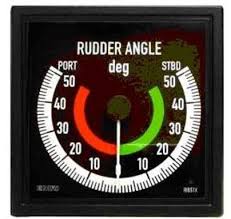
Displays the real-time position of the rudder blade relative to the vessel’s centerline.
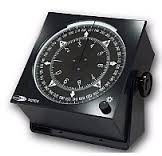
Indicates the true heading. The helmsman alternates focus between the gyro card and the rudder indicator.
If the ship fails to answer the helm or shears against applied rudder due to external currents, shallow water effects, or bank cushion, the helmsman must report immediately: «Vessel not answering the helm, Sir!»
3. Standard Steering Orders (IMO SMCP Section B1/1.1)
Bridge seamanship requires closed-loop communication: 1) Conn issues order → 2) Helmsman repeats verbatim → 3) Helmsman executes → 4) Helmsman reports completion.
| IMO SMCP Command | Meaning & Required Execution |
|---|---|
| Midships | Rudder blade to zero degrees on the indicator. |
| Port / Starboard five (ten, twenty) | Apply specified rudder angle (5°, 10°, 20°) to the ordered side. |
| Hard-a-port / Hard-a-starboard | Rudder fully over to maximum mechanical limit (usually 35°). |
| Ease to five (ten) | Reduce rudder angle back to 5° or 10°. |
| Meet her / Check her | Apply counter-rudder to stop the vessel’s swing / rate of turn. |
| Steady / Steady as she goes | Steady heading on the exact course the ship is heading at the moment of order. |
| Nothing to starboard / Nothing to port | Do not allow heading to swing past the specified heading to that side. |
| Steer on the buoy / beacon | Keep the ship’s head aligned directly with the indicated visual mark. |
Standard Closed-Loop Bridge Exchange:
Pilot / Conning Officer: «Starboard 10!»
Helmsman (readback): «Starboard 10, Sir.» (helmsman puts wheel over until indicator reads 10° starboard).
Helmsman (execution report): «Rudder is starboard ten, Sir.»
Pilot: «Steady on zero-eight-two!»
Helmsman (readback): «Steady on zero-eight-two, Sir.» (approximately 10°–15° before heading 082°, counter-rudder is applied to check the swing).
Helmsman (on-course report): «Steady on course zero-eight-two, Sir.»
Course Number Pronunciation under IMO SMCP:
Each digit of a course is pronounced separately. The digit «3» is pronounced as TREE, and «0» is pronounced as ZERO:
• 005°: Zero-Zero-Five
• 090°: Zero-Nine-Zero
• 235°: Two-Tree-Five
4. Relieving and Handing Over the Helm
The procedure for relieving the helmsman is strictly regulated under the Bridge Procedures Guide:
- No Handover During Manoeuvres: Never relieve the helm while the ship is altering course, executing a swing, or resolving a critical traffic encounter. Handover occurs only when the vessel is steady on course.
- Permission to Relieve: The relieving helmsman requests permission clearly from the OOW: «Permission to relieve the helm, Sir?».
- Data to Transfer: The incoming helmsman stands by the wheel, cross-checking the gyro repeater and rudder indicator. The outgoing helmsman reports:
- Current course by gyro and magnetic compass.
- Rudder offset angle needed to hold course against wind or current.
- Vessel yaw tendencies and handling peculiarities.
- Supervision Period: The relieved rating does not leave the bridge immediately — they stand by for 1–2 minutes until satisfied the replacement has complete feel and control of the ship.
5. The «20–20» Manoeuvre: Checking Vessel Headway
In confined waterways or during emergency deceleration where circular turning room is unavailable, large alternate rudder angles (the 20–20 manoeuvre) can shed headway rapidly:
The engine is stopped or adjusted to minimum pitch. The rudder is put hard over to 20° on one side. As soon as the bow swings 15°–20° off track, the rudder is shifted to 20° on the opposite side to arrest the turn. The hydrodynamic drag of the broad rudder blade and hull resistance reduce speed through the water far quicker than coasting alone.