
Maritime Law // Technical Oversight & Statutory Surveys
Classification Societies in the Maritime Industry
A comprehensive guide to the functions, legal authority, and survey schedules of marine classification societies: tracing origins from Edward Lloyd’s Coffee House to the International Association of Classification Societies (IACS), delineating Class versus Flag State boundaries, Recognized Organization (RO) status, and the Harmonized System of Survey and Certification (HSSC).
Without classification societies, the maritime world would lack universal structural benchmarks and verified engineering standards for ships and marine structures.
The Role and Historical Origins of Classification
The origins of classification trace back to the mid-1700s in London, England, where marine underwriters sought reliable methods to assess the hull integrity and equipment condition of insured merchant tonnage.
This operational framework involved assigning alphanumeric condition grades to vessels, providing transparency for marine insurance underwriting and risk pricing.
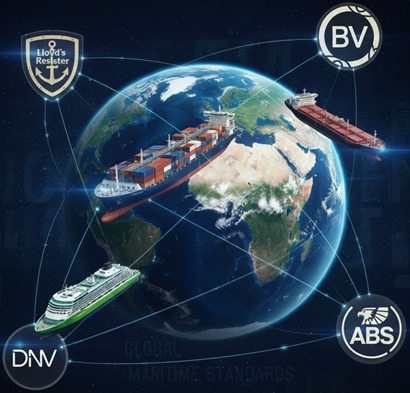
Because these underwriters, shipbrokers, and merchants gathered routinely at Lloyd’s Coffee House, their collected assessment records became formally recognized as Lloyd’s Register, officially established in 1764.
In subsequent decades, other independent national registers emerged to serve expanding trade lanes: Bureau Veritas in 1828 (Belgium/France), Det Norske Veritas (DNV) in 1864 (Norway), and Germanischer Lloyd in 1867 (Germany)—with the latter two merging in modern times into DNV.
The Significance of Marine Classification
Today, the international maritime domain relies on major classification societies to establish engineering rules, survey vessel hulls and propulsion systems throughout their operational lifecycle, and verify compliance for offshore assets.
- BV (Bureau Veritas) — France;
- DNV (Det Norske Veritas) — Norway / Germany;
- ABS (American Bureau of Shipping) — United States;
- NK (ClassNK / Nippon Kaiji Kyokai) — Japan;
- LR (Lloyd’s Register) — United Kingdom;
- RINA (Registro Italiano Navale) — Italy;
- RS (Russian Maritime Register of Shipping).


A classification society is a private technical entity rather than a sovereign governmental agency. Consequently, societies maintain standard liability disclaimer clauses regarding latent defects. However, operating without an active class certificate renders a vessel commercially unseaworthy: it cannot obtain P&I or H&M insurance cover (detailed in Ship’s Business for Shipmasters) and will be denied port entry worldwide.
International conventions including SOLAS 1974 and UNCLOS explicitly mandate that vessels must be designed, constructed, and maintained in structural compliance with the rules of an established classification society.
Delineation of Responsibilities: Class vs. Flag State
In maritime law, distinguishing between the functions of Classification Societies and Flag State Administrations is vital. Class focuses primarily on structural and mechanical integrity (hull scantlings, main engine reliability, boiler safety), whereas the Flag State oversees statutory convention compliance (crew welfare, lifesaving equipment, environmental pollution prevention, and watchkeeping standards as described in Top 10 Flag States in Shipping).
In practice, these jurisdictions frequently converge. Most national maritime administrations delegate statutory inspection authority to IACS-member societies, officially designating them as Recognized Organizations (ROs). In this capacity, classification surveyors audit ships on behalf of the Flag State, issuing statutory international certificates under SOLAS, MARPOL, Load Line, and the Maritime Labour Convention (MLC 2006).
Contemporary Trends: Digitalization and Decarbonization
Classification societies are evolving under the twin drivers of digital transformation and stringent environmental mandates from the IMO:
- Remote Surveys: Deploying aerial drones for internal tank inspections, climbing robots for ultrasonic thickness measurements, high-definition streaming, and augmented reality (AR) enables class attendance without placing a surveyor physically on board, reducing drydock delays;
- Decarbonization Rules: Societies lead the maritime energy transition by formulating safety standards for alternative marine fuels (ammonia, hydrogen, LNG, methanol) and Carbon Capture and Storage (CCS) systems. Novel environmental propulsion plants require formal Class Type Approval before deployment;
- Maritime Cyber Resilience (IACS UR E26 / E27): With the expansion of integrated digital bridges, ECDIS interfaces, and autonomous systems (MASS), class rules govern cyber resilience, auditing onboard operational networks against cyber attacks and verifying system redundancy.
International Association of Classification Societies (IACS)
To secure membership in IACS, an organization must satisfy the rigorous benchmarks of the IACS Quality System Certification Scheme (QSCS). Each member society contributes to technical working groups that draft Unified Requirements (UR) and Unified Interpretations (UI). Together, IACS member societies cover over 90% of the world’s commercial trading tonnage.

Scope of Duties and Operational Responsibilities
Throughout a vessel’s design, construction, and operating life, a classification society carries out several critical tasks:
- Developing comprehensive Class Notations and technical rules for hull structures and machinery plants;
- Reviewing naval architecture plans, structural scantlings, intact stability calculations, and damage stability models;
- Certifying marine-grade steel plates, testing forgings, anchor chain cables, winches, and pressure vessels during manufacture;
- Overseeing quay trials, inclining experiments, and sea trials prior to commissioning;
- Issuing the Certificate of Class and recording vessel particulars in published registers;
- Conducting periodic surveys of cargo systems, including tanker inert gas systems (IGS) and deepwell pumps (see our guide on Tanker Cargo Technical Handbook);
- Auditing safety management systems under the ISM Code, issuing corporate Documents of Compliance (DOC) and Safety Management Certificates (SMC);
- Authorizing Underwater Inspection in Lieu of Drydocking (UWILD) surveys for eligible modern hulls fitted with approved anti-corrosive coating systems (evaluated in our marine painting and coating guide).
Harmonized System of Survey and Certification (HSSC) Schedule
The periodicity of class and statutory surveys is standardized under the IMO Harmonized System of Survey and Certification (HSSC), aligning class renewal milestones with international convention expiry windows:
| Survey Category | Required Frequency | Operational Scope and Inspection Focus |
|---|---|---|
| Annual Survey | Every 12 months (within an operational window of ±3 months from the anniversary date) | Visual inspection of hull structures, deck fittings, steering machinery, fire protection arrangements, watertight closures, and safety systems to verify sound operational condition. |
| Intermediate Survey | Held in lieu of the 2nd or 3rd Annual Survey | An expanded inspection involving internal examination of selected water ballast tanks, cargo holds, electrical insulation testing, and operational parameter checks on critical machinery. |
| Bottom / Docking Survey | Twice within any 5-year cycle (maximum interval between inspections not to exceed 36 months) | Drydock inspection of underwater shell plating, sea chests, propeller clearances, stern tube bearings, rudder pintles, and outboard overboard discharge valves. |
| Special / Renewal Survey | Every 5 years (marking the completion of a full class cycle) | A comprehensive overhaul survey: extensive ultrasonic thickness measurements (UTM) of hull steel, internal inspection of all tanks, machinery overhauls, pressure testing, and renewal of the Certificate of Class for a subsequent 5-year period. |
| Occasional / Damage Survey | Conducted on an unscheduled basis | Triggered following collisions, groundings, mechanical breakdowns, or when major structural conversions are undertaken. |
Frequently Asked Questions: Classification Societies (FAQ)