
Ship’s Business // Maritime Law & Commercial Risk Management
Ship’s Business: 10 Documents That Separate a Master from “Just a Navigator”
The Master of a modern merchant vessel is entrusted not only with navigation, but with safeguarding the commercial, legal, and contractual interests of the shipowner. Errors in Bills of Lading, Charter Parties, or marine protests lead to vessel arrests, multi-million-dollar cargo claims, and severe reputational damage.
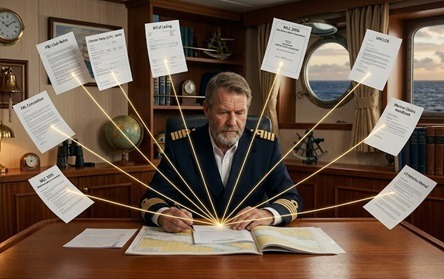
Below is an analysis of the ten legal disciplines and operational documents that every Master must command to safeguard the shipowner’s balance sheet and protect their own master mariner certificate of competency.
The Essence: The operational statutes and indemnity rules of the vessel’s Protection and Indemnity (P&I) Club.
Why It Matters: The Master acts as the insurer’s primary representative on board. You must know the mandatory response protocols for cargo contamination, crew injury, or collision. Flawed initial reports, admissions of liability, or failing to appoint an independent Club surveyor immediately give underwriters legitimate grounds to reject insurance claims and deny cover.
The Essence: The governing commercial contract executed between the shipowner and the charterer (e.g., standard NYPE, GENCON, Shelltime, or Asbatankvoy forms).
Why It Matters: The Master must understand the contractual mechanics of Laytime and Demurrage. Misinterpreting when and where a Notice of Readiness (NOR) becomes legally valid (such as WWD, WIPON, or WIBON terms) can forfeit tens of thousands of dollars in legitimate waiting time, directly impacting the shipowner’s revenue.
The Essence: Receipt for cargo shipped, document of title, and prima facie evidence of the contract of carriage.
Why It Matters: This is the highest-risk document in merchant shipping. The Master must know when to clause the Bill of Lading (claused B/L), how to cross-reference figures with the cargo manifest, and why releasing cargo without an original bill or without a validated, bank-backed Letter of Indemnity (LOI) exposes the ship to total commercial forfeiture. Signing a clean B/L for damaged cargo is legally classified as fraud, terminating insurance protection.
The Essence: The IMO convention governing standardized clearance formalities for ships arriving in, staying at, and departing from international ports.
Why It Matters: Severe financial penalties and vessel detentions arise from customs discrepancies, stowaway incidents, and undeclared ship stores. The Master is personally liable for ensuring that port customs declarations, crew effects lists, and bonded store inventories match physical quantities exactly. With mandatory Maritime Single Window (MSW) data exchange, mastering FAL standards prevents costly port entry delays.
The Essence: The International Labour Organization’s comprehensive charter protecting seafarers’ working and living conditions (“The Seafarers’ Bill of Rights”).
Why It Matters: MLC compliance directly affects vessel operational capability and Port State Control (PSC) detention profiles. The Master must verify financial security certificates covering repatriation and crew compensation, manage on-board complaint procedures impartially, and maintain accurate rest hours under STCW limits, preventing union disputes or ship arrests in port.
Summary Risk Matrix: Shipmaster’s Primary Control Checkpoints
| Document / Legal Domain | Primary Commercial Risk for the Master | Critical On-Scene Checkpoint |
|---|---|---|
| P&I Club Rules | Repudiation of insurance cover and claim denial | Timely notification, preserving contemporaneous evidence, joint surveys |
| Charter Party | Financial recovery claims (Speed, Consumption, Off-hire) | Speed and consumption logs, strict adherence to valid NOR tendering |
| Bill of Lading | Shortage and cargo damage claims, cargo fraud | Verifying ship’s figures against shore tallies; inserting clausing remarks |
| FAL Convention | Customs fines, port detention, stowaway liabilities | Auditing Cargo Declarations, securing Bonded Stores, anti-stowaway searches |
| Letter of Protest | Unsubstantiated legal defense during arbitration | Prompt, contemporaneous written lodging and counter-signing of protests |
The Essence: The universal legal constitution governing sovereignty, maritime zones, and jurisdictional rights across the world’s oceans.
Why It Matters: The Master must recognize the exact legal status of internal waters, territorial seas, contiguous zones, and the Exclusive Economic Zone (EEZ). Does a coastal state patrol have the right to board and inspect the vessel 20 miles offshore? What are the strict legal limitations of Innocent Passage? A thorough grasp of UNCLOS provides the Master with solid legal arguments when challenged by foreign coastal authorities.
The Essence: The Master’s formal written declaration documenting breach of contract, excessive terminal delays, off-spec bunkering, or external damage.
Why It Matters: The foremost legal shield of the shipowner. The Master must know how to draft and serve an indisputable protest for contaminated bunker supplies, stevedore damage, excessive manifold pressure, or slow discharge rates. If a protest is not issued contemporaneously, arbitrators will proceed under the legal presumption that no breach occurred.
The Essence: The domestic maritime acts, marine notices, and statutory decrees issued by the vessel’s nation of registry (e.g., Panama, Liberia, Marshall Islands, Cyprus).
Why It Matters: While the IMO outlines general conventions, Flag State law grants the Master their legal command authority, notarization rights, and disciplinary powers on board. It regulates birth and death certifications at sea, official logbook administration, and Minimum Safe Manning mandates. Breaching Flag State circulars can compromise a vessel’s legal seaworthiness (unseaworthy) under marine insurance contracts.
The Essence: Operational guidelines governing legal evidence preservation and post-casualty claim management.
Why It Matters: How should the bridge team respond when maritime attorneys or court bailiffs board the vessel seeking to arrest cargo or secure evidence? The Master must enforce the doctrine of legal privilege, distinguishing between confidential communications prepared exclusively for legal defense (Privileged Documents) and statutory public records (e.g., official logbooks, VDR data).
The Essence: Administrative and legal protocols following pollution incidents, salvage, and environmental damage under MARPOL.
Why It Matters: Beyond containment steps outlined in the shipboard SOPEP/SMPEP, the Master must manage the complex administrative fallout: securing Club guarantees (LOU — Letter of Undertaking) to lift detention orders and managing initial investigatory interviews to protect the crew from unlawful detention or criminalization under coastal state jurisdictions.
Commanding a vessel requires balancing safe seamanship with commercial vigilance. Mastering these legal documents gives the shipmaster the authority and confidence to push back against unreasonable charterer instructions or terminal demands whenever vessel safety or the owner’s legal exposure is compromised.
Frequently Asked Questions: Ship’s Business (FAQ)