
Bridge Watchkeeping // Maritime Safety & Tanker Vetting
Master Standing Orders: SIRE 2.0 Standards and Bridge Watchkeeping Mandates
A practical operational analysis of Master Standing Orders under the OCIMF SIRE 2.0 inspection framework. Statutory foundations in the STCW Convention and ICS Bridge Procedures Guide, structured closed-loop command transfer protocols, institutionalizing Challenge and Response, personal device distraction bans, high-latitude operational constraints, and an approved downloadable template for shipboard SMS integration.
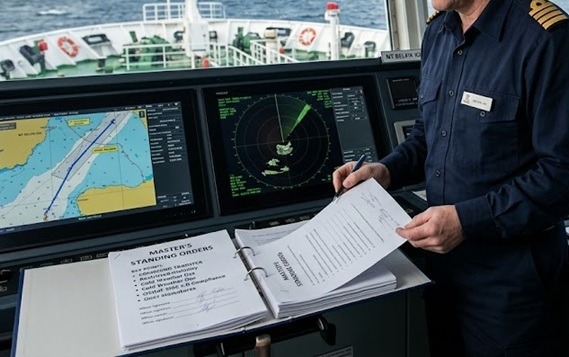
Under the OCIMF SIRE 2.0 vetting inspection regime, auditing focus has shifted fundamentally from document verification toward evaluating Human Factors. Surveyors no longer settle for signatures on paper; they conduct detailed interviews with watchkeepers to determine whether standing orders are understood and executed in practical bridge operations.
Below is an in-depth operational analysis of the statutory framework governing standing orders, the deficiencies most frequently noted during vetting audits, and adjustments required for vessels operating in demanding environments, such as polar routes or the Barents Sea.
Statutory Authority and Regulatory Framework
Master Standing Orders derive their authority from international maritime conventions and tanker industry benchmarks:
- International Convention on Standards of Training, Certification and Watchkeeping (STCW 78/95): Defines global benchmarks for maintaining a navigational watch and establishes the absolute authority and operational responsibility of the Officer of the Watch (OOW);
- ICS Bridge Procedures Guide (6th Edition): The international operational benchmark for bridge procedures (reviewed in our guide to 10 publications every navigator must know), incorporating checklists standardly embedded into corporate Safety Management Systems (SMS);
- OCIMF SIRE 2.0 Question Library (Navigation Chapter): The core technical syllabus against which commercial tankers are evaluated. Vetting inspectors search for verifiable Objective Evidence demonstrating that Master’s instructions reflect actual passage hazards and are fully understood by watchkeeping personnel.
Core SIRE 2.0 Mandates for Master Standing Orders
Standing orders drafted years ago generally fail to meet current SIRE 2.0 expectations. Audits require specific focus on the following operational clauses:
The orders must eliminate ambiguity when the Master enters the wheelhouse. Vague notions such as “the Master assumed control upon arrival on the bridge” are unacceptable during vetting audits. A formal closed-loop verbal exchange must be defined:
• The Officer of the Watch (OOW) repeats: “You have the con, Captain.”
• The exact time of command transfer is entered immediately in the official logbook.
Until this verbal exchange is completed, the Officer of the Watch remains legally responsible for vessel handling and collision avoidance, even if the Master is physically present and observing the radar.
SIRE 2.0 focuses on eliminating rigid authority gradients on the bridge. Standing orders must state unequivocally that every junior officer, navigation apprentice, and rating is expected and required to challenge or stop any action initiated by a senior officer or pilot if they perceive a hazard to the ship’s safety.
Unauthorized mobile device usage during watchkeeping is treated as a major audit deficiency. Standing orders must document a strict prohibition against operating personal mobile phones, tablets, smartwatches, or media players on the navigation bridge. Personal electronics must remain powered off or stowed outside conning positions.
OCIMF strictly rejects the practice of negotiating collision avoidance maneuvers over VHF radio. Standing orders must state that VHF and AIS are not collision avoidance instruments. Collision avoidance must strictly follow the International Regulations for Preventing Collisions at Sea (COLREGs 1972), executing early and substantial maneuvers.
Unquestioning reliance on ECDIS positions is a critical navigational risk. In coastal areas and regions prone to electronic jamming or GNSS spoofing, officers must cross-check satellite positions regularly using independent terrestrial methods: radar ranges and bearings, visual marks, and parallel indexing.
Cold-Weather and High-Latitude Operating Directives
For vessels transiting Arctic waters, northern trade routes, or the Barents Sea, generic company templates fail vetting verification. Standing orders must include dedicated instructions addressing cold-weather and ice navigation hazards.
A dedicated ICING / COLD WEATHER section must be incorporated, setting clear operational triggers:
| Cold-Weather Environmental Factor | Required Instruction in Standing Orders | Watch Officer Action Trigger |
|---|---|---|
| Visibility Thresholds | Restricted visibility in polar waters must be defined by an explicit numerical value (typically 2 nautical miles or less). | Post an additional lookout, engage manual hand steering, verify active status of the BNWAS, and sound fog signals. |
| Sub-Zero Temperature Limits | Ambient air temperatures falling below -10°C or the onset of topside structural icing. | Mandatory operational trigger to notify the Master immediately, as detailed in our guide to Helmsman Watch & Steering Orders. |
| First Ice Encounters | Initial visual or radar detection of pancake ice, frazil ice, slush, or brash ice. | Reduce speed to minimize hull impact, call the Master to the bridge, and establish dedicated ice lookouts. |
| Radar Target Detection for Small Ice | Specific radar tuning procedures adjusting manual Gain, Sea, and Rain Clutter controls. | Detect growlers and small bergy bits that are frequently filtered out by automatic anti-clutter algorithms. |
| Open Deck Access Restrictions | Establishment of an Out of Bounds policy prohibiting crew access to open decks during rough seas and freezing spray. | Deck access permitted only with the Master’s explicit authorization and a formal assessment via our Marine Risk Assessment Tool. |
Requirement for Deck Ratings to Acknowledge Standing Orders
Prior to countersigning, the Master or Chief Mate must conduct a concise briefing in the ship’s working language. Ratings’ signatures at the end of the document provide verified Objective Evidence for vetting inspectors, proving that safety management standards are communicated across all crew ranks. Handover and watch assignment procedures can be cross-referenced with the 3rd Officer Handover Checklist.
Standing Orders Verification Checklist
Review your vessel’s existing Master Standing Orders against the following criteria. Missing provisions require immediate procedural updates:
- Is closed-loop verbal dialogue defined for command transfer? (The explicit exchange “I have the con” — “You have the con, Captain”);
- Is restricted visibility stated as a numerical threshold? (e.g., exactly 2.0 NM, rather than subjective phrases like “in poor visibility”);
- Is personal electronic device usage on the bridge strictly prohibited? (Explicit ban covering mobile phones and wearable smart devices);
- Is using VHF for collision avoidance explicitly forbidden? (Reaffirming absolute compliance with COLREGs steering rules);
- Are cold-weather and regional navigational hazards incorporated? (Sub-zero limits, icing watches, and deck Out of Bounds policies).
Navigational discipline begins with clear, practical, and legally sound Master Standing Orders.
Download Master Standing Orders Template (High-Latitude & SIRE 2.0 Compliant)
NavLib has prepared a comprehensive, operational Master Standing Orders template adapted to SIRE 2.0 vetting standards and high-latitude operations. Drafted in clear maritime English, it is structured for immediate implementation into shipboard Safety Management Systems (SMS).
Master Standing Orders Draft (SIRE 2.0 & Polar/Arctic Operations)
A professional marine template featuring closed-loop command transfer phrasing, Challenge and Response protocols, distraction policies, cold-weather procedures, and sign-off sheets for officers and deck ratings.
Share your operational feedback below: what calling-the-Master parameters are enforced aboard your vessels, and what questions regarding Challenge and Response have arisen during recent inspections?
Frequently Asked Questions: Master Standing Orders (FAQ)