
Deck Maintenance // Corrosion Protection & Hull Preservation
The Art of Battling Corrosion: Marine Painting and Coating Operations
A comprehensive technical guide to shipboard painting, surface preparation, and corrosion mitigation for deck crews and ship officers. Steel preparation standards under ISO 8501-1 (St 2/St 3, Sa 2.5), coating system anatomy, global marine coatings (Jotun, Hempel, Sigma, International), environmental rules (the dew point rule, stripe coating), an engineering paint compatibility matrix, and troubleshooting common coating failures.
1. The Foundation of Success: Surface Preparation
Before opening a drum of high-grade paint from Jotun or Hempel, every deck officer must remember the fundamental rule of corrosion engineering: 80% of coating longevity depends on surface preparation, and only 20% on the paint itself.
Onboard deck maintenance and shipyard refits encounter three primary surface preparation methods under ISO 8501-1:
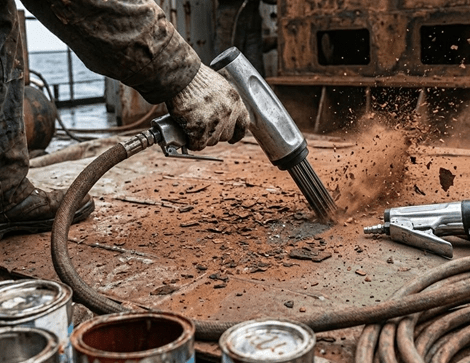
- Mechanical Cleaning (St 2 / St 3): Hand- and power-tool cleaning using wire brushes, scrapers, scaling hammers, or pneumatic needle guns. St 2 represents thorough scraping and wire-brushing, while St 3 requires very thorough cleaning until a faint metallic sheen appears. This is the standard operational baseline for onboard touch-up maintenance;
- Abrasive Blast-Cleaning (Sa 2.5): The drydock gold standard (“Near-White Metal”). Steel is blasted with grit or copper slag until 95% of every section is free of all visible residue, mill scale, and rust. This process creates the required surface anchor profile (roughness of 50–75 μm), allowing the primer to mechanically key into the metal;
- Ultra-High Pressure Hydroblasting (UHP Water Jetting): Stripping paint and rust using fresh water pressurized above 2,000–2,500 bar. This method eliminates airborne dust and washes out entrained chlorides, but requires immediate moisture-tolerant primers to prevent flash rust.
2. Anatomy of the Coating “Sandwich”: Primer, Intermediate & Topcoat
A marine coating specification is an engineered multilayer composite system, where each coat performs a distinct electrochemical or physical role:
The primer acts as both adhesive and shield. Its primary objectives are substrate adhesion and active corrosion inhibition. The most common marine primers are two-pack epoxy primers, forming an impermeable moisture barrier. Additionally, zinc-rich primers provide galvanic (cathodic sacrificial) protection: the zinc particles oxidize preferentially, shielding the underlying steel substrate.
The intermediate coat increases total dry film thickness (DFT), slows moisture vapor transmission, and enhances intercoat adhesion between heavy barrier primers and cosmetic finish coats. In shipboard practice, intermediate coats are tinted in a contrasting shade: if the finish layer experiences mechanical abrasion, the deck watch immediately spots the damage before rust can form.
The topcoat provides color retention, gloss, and resistance to environmental degradation. On superstructures and bulwarks, two-pack aliphatic polyurethane paints are standard: they resist solar ultraviolet radiation without chalking or yellowing. For working decks and walkways, tough epoxy finishes incorporate silica sand to generate non-skid (anti-skid) textures.
3. Global Marine Paint Manufacturers
The international shipping industry is dominated by four major paint manufacturers, with shipowners aligning their maintenance fleets with specific brand specifications:
| Manufacturer | Origin & Focus | Flagship Product Lines | Onboard Operational Profile |
|---|---|---|---|
| Jotun | Norway. Offshore & Tanker Fleets. |
Jotamastic 90 (surface-tolerant epoxy primer), Hardtop AX / XP (polyurethane), SeaForce (antifouling). | A fleet favorite for ship’s crew maintenance. The surface-tolerant Jotamastic series tolerates minor imperfections typical of manual St 2 scraping. |
| Sigma Coatings (PPG) | USA / Netherlands. Cargo & Chemical Tanks. |
Sigmaglide (silicone release), Sigmashield (abrasion-resistant), Sigmaprime (universal primer). | Renowned for heavy-duty tank linings, offering high chemical resistance for chemical parcel tankers and ballast spaces. |
| International (AkzoNobel) | United Kingdom. Pioneer in Marine Coatings. |
Intershield 300 (benchmark ballast tank epoxy), Interthane (polyurethane), Interline (cargo tank lining). | Widely specified for newbuild contracts at Asian yards; Intershield 300 is an industry benchmark for IMO PSPC ballast tank rules. |
| Hempel | Denmark. Fouling Defense Innovation. |
Hempadur (epoxies), Hempaguard (silicone-hydrogel), Hempatop (acrylic & polyurethane topcoats). | Hempaguard silicone-hydrogel underwater systems yield substantial hydrodynamic drag reductions, saving up to 6–8% in bunker fuel consumption. |
4. Specialized Marine Coating Categories
Applied exclusively below the deep waterline to deter biofouling. Historically reliant on organotin compounds (TBT was banned globally under the IMO AFS Convention), modern technologies operate under two primary mechanisms:
- Self-Polishing Copolymers (SPC): Under the mechanical action of water flow, the outer binder micro-layer slowly hydrolyzes and washes away, constantly exposing fresh active biocide. SPC coatings require regular vessel movement at sea to remain effective;
- Fouling Release Systems (FRS / Silicone): Biocide-free, non-toxic technologies. The silicone surface is ultra-smooth and low-surface-energy, preventing barnacles, tubeworms, and macroalgae from bonding. Slime and fouling wash off dynamically once ship speed exceeds 10–12 knots.
Engine exhaust gas manifolds, steam lines, and boiler uptakes reach operating temperatures where alkyd and standard epoxy coatings carbonize above 200°C. Specialized silicone-aluminum and inorganic silicate formulations are required, withstanding continuous exposure up to 600°C without blistering or delaminating.
Tank linings represent the highest tier of marine coating technology. Linings must remain chemically inert, prevent product contamination (such as aviation fuel Jet A-1, potable alcohol, or edible oils), and resist hot chemical washings. Detailed washing and tank turnaround protocols are outlined in our practical tank cleaning guide for chemical tankers.
5. Practical Guidelines for the Deck Team
Painting on a vessel is not mere busywork; it preserves multi-million-dollar hull assets. Understanding the underlying physical chemistry elevates seamanship, transforming routine painting into professional maintenance.
Even the most expensive coating will fail prematurely if manufacturer Technical Data Sheets (TDS) are ignored:
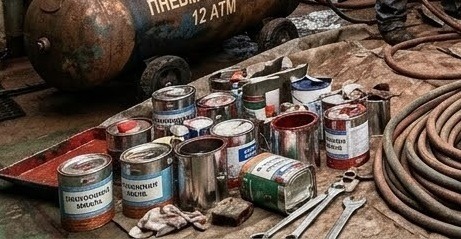
1. The 3°C Dew Point Rule: Never apply paint unless steel substrate temperature is at least 3°C above the ambient dew point! Microscopic, invisible moisture condensation trapped under a fresh paint film causes osmotic blistering and rapid sub-film corrosion within weeks;
2. Accurate Mixing Ratios: Two-pack coatings (base and hardener/curing agent) require exact volumetric proportioning. Guessing ratios causes incomplete polymerization: the paint either stays permanently tacky or becomes brittle, cracking under hull flexing;
3. Pot Life Discipline: Every mixed two-component paint has a defined pot life at a given temperature. Once cross-linking increases viscosity and the mix warms up, discard it. Adding thinner to an expired pot ruins the molecular structure, yielding a porous film;
4. Stripe Coating: Before rolling or airless spraying large plate areas, brush-apply paint along every weld seam, plate edge, cut-out, and bracket corner. Liquid paint draws away from sharp profiles due to surface tension, leaving half the target dry film thickness. Corrosion always begins at the edges!
6. Personnel Safety & Enclosed Space Precautions
Marine paints, hardeners, and thinners contain toxic volatile organic compounds (VOCs) and flammable solvents. Inhaling concentrated vapors can damage the central nervous system or cause chemical pneumonitis, while amine hardeners trigger severe allergic contact dermatitis.
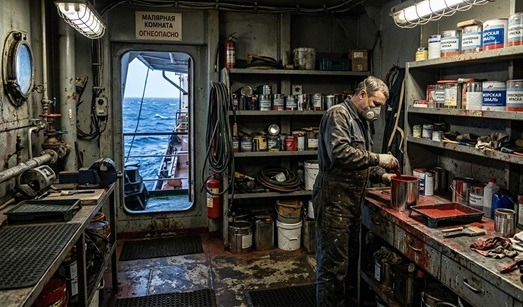
• Coating work inside enclosed spaces (ballast tanks, cofferdams, forepeak) constitutes hazardous work: a formal Enclosed Space Entry Permit must be logged, with continuous forced ventilation and gas monitoring for LEL, O₂, and toxic vapors;
• Certified Personal Protective Equipment (PPE) is mandatory: organic vapor respirators with particulate pre-filters (A2P3), chemical-resistant nitrile gloves, and eye protection;
• Inside paint lockers and cargo holds, only certified explosion-proof (Ex-rated) lighting and grounded pneumatic equipment are permitted. Prior to beginning hazardous painting tasks, review procedural requirements using the Marine Risk Assessment Tool.
Technical Appendix: Coating Specification & Application Guide
1. Marine Coating System Compatibility Matrix
A frequent shipboard failure involves applying an aggressive, solvent-rich paint over an incompatible existing coat. Applying a heavy two-pack aromatic epoxy over an aged alkyd enamel causes the solvent to dissolve the alkyd layer, blistering the new coating.
| Existing Cured Layer | Epoxy | Polyurethane (PU) | Alkyd | Vinyl | Acrylic |
|---|---|---|---|---|---|
| Epoxy | C | C | C | T | C |
| Polyurethane | T | C | C | I | C |
| Alkyd | I | I | C | I | C |
| Vinyl | I | I | T | C | C |
| Chlorinated Rubber | I | I | T | C | C |
• C — Compatible: Can be applied directly, observing recoat intervals and ensuring a clean, degreased surface;
• T — Tie-Coat Required: Demands an intermediate bonding tie-coat or thorough mechanical abrading;
• I — Incompatible: Solvents in the topcoat will lift, dissolve, or detach the existing coat.
Before applying a fresh coat over an existing sound system weathered for over six months, the surface must undergo light sweep blasting or mechanical sanding, followed by high-pressure fresh water washing to remove marine salts and chalking residues.
2. Marine Coating Defect Identification & Remedy Guide
An experienced deck hand and duty officer should interpret coating degradation just as navigators read charts. Below are common paint failures and corrective actions:
• Visual Appearance: Hemispherical bubbles varying from pinhead size to several centimeters across, frequently containing trapped liquid;
• Root Cause: Osmotic pressure. Coating over unwashed marine salts, moisture condensation (violating the dew point rule), or solvent entrapment from applying topcoats before the primer releases volatiles;
• Remedial Action: Scrape open blisters, blast or needle-scale back to bare steel (St 3 / Sa 2.5), wash thoroughly with fresh water to remove soluble salts, dry, and reapply the specified coating system.
• Visual Appearance: A friable, chalk-like white powder on the surface, causing loss of gloss and color fading;
• Root Cause: Photochemical degradation of the polymer binder under solar ultraviolet (UV) radiation. Standard epoxy resins chalk rapidly when exposed to sunlight;
• Remedial Action: Wash down with fresh water under pressure using abrasive scrubbers to remove loose powder, then apply an aliphatic polyurethane topcoat.
• Visual Appearance: Interconnected crack patterns resembling the scales of an alligator hide;
• Root Cause: Tensile stress mismatch. Applying a hard, rigid coating (such as an epoxy) over a soft, flexible, or uncured primer (like bitumen or alkyd). The topcoat contracts faster during curing than the flexible sub-layer can accommodate;
• Remedial Action: Completely remove the failed coating layers down to a sound substrate or bare metal, and reapply compatible layers.
• Visual Appearance: Downward curtain-like runs, teardrops, and heavy ridges on vertical surfaces;
• Root Cause: Excessive wet film thickness (WFT), adding too much thinner, or holding the spray gun too close to the bulkhead;
• Remedial Action: Allow the paint to cure completely, sand down the runs until the surface is flush, and reapply a uniform, controlled coat.
Quality marine paint is a major operational investment, and reworking premature coating failures triples labor costs. Adhering to manufacturer Technical Data Sheets (TDS) ensures vessel structural integrity and maintains clean topsides until the next drydock period.
Frequently Asked Questions: Marine Painting & Coating (FAQ)