
Navigation Watchkeeping // Passage Planning
Points of No Return in Passage Planning: Calculating and Plotting the Abort Point and Point of No Return (PONR)
A practical guide for navigation officers on determining and displaying critical operational thresholds when approaching ports, narrow channels, and confined waters. Distinguishing the Abort Point from the Point of No Return, accounting for shallow-water manoeuvring data, resolving pilot boarding ground conflicts, and establishing robust contingency plans.
In accordance with IMO Resolution A.893(21) (Guidelines for Voyage Planning) and the ICS Bridge Procedures Guide, every comprehensive berth-to-berth passage plan must calculate and clearly plot two foundational operational marks: the Abort Point and the Point of No Return (PONR).
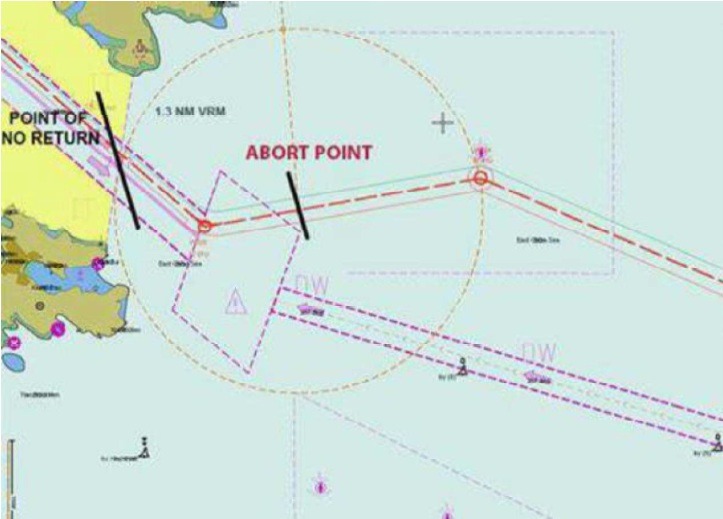
1. Conceptual Definitions: Abort Point vs. Point of No Return
Bridge teams must clearly differentiate between these two terms, as they represent entirely different operational risk levels and vessel capabilities:
The Abort Point is the final geographical position along the route where the vessel still has sufficient sea room to execute a safe 180° turn back into open waters using its own engine and rudder, should an emergency arise, equipment fail, or port entry clearance be revoked by Vessel Traffic Services (VTS).
The Point of No Return (PONR) is the critical point past which the vessel is fully committed to proceeding ahead. Returning is physically impossible. Beyond the PONR, channel width or environmental factors prevent a 180° turn, even with emergency assistance such as full astern power, anchor deployment, or emergency tug assistance.
| Scenario Inducing PONR | Underlying Physical Constraint | Operational Reality for Bridge Teams |
|---|---|---|
| Geometric Boundary (Narrow Channels) | The navigable channel width is narrower than the vessel’s tactical diameter, accounting for drift and stern kick around the Pivot Point of the ship. | Any attempt to turn will ground the bow or stern on channel banks. The vessel must proceed ahead until reaching an authorized turning basin or anchorage. |
| Hydrodynamic Boundary (Tidal Windows) | Transiting a shallow bar or dredged cut during a narrow high-water tidal window on a falling tide. | Once past the PONR, the vessel cannot turn back and escape to deep water before falling water levels breach minimum safety margins under the Under-Keel Clearance (UKC) Policy. |
2. Mathematical Calculation and Shallow-Water Hydrodynamics
Estimating an Abort Point arbitrarily creates a false sense of security. The calculation must be derived from verified ship trial data found in the Manoeuvring Booklet and Wheelhouse Poster, using shallow-water data for the vessel’s loaded or ballast displacement.
• Advance (Head Reach): The distance traveled by the vessel’s center of gravity along the original course line from the initial helm order until the heading changes by 90°;
• Tactical Diameter (Side Reach): The lateral distance between the original course line and the vessel’s centerline after turning through 180°.
Vapproach is planned speed over the ground (in knots);
(5 / 60) represents a mandatory 5-minute situational assessment buffer.
In shallow water, turning performance deteriorates significantly: tactical diameter increases by 30% to 70% due to bottom cushion effects, directional yaw inertia, and dynamic hull sinkage calculated with the Ship Squat Calculator. Doubling the larger parameter provides a safety buffer ensuring the turning envelope remains within surveyed safe contours despite wind and tidal stream.
• Initial Data: A loaded bulk carrier approaches a fairway at V = 6 knots. Shallow-water tactical diameter from the wheelhouse poster is 0.4 NM.
• Step 1 (5-minute distance buffer): 6 knots × (5 / 60) h = 0.5 NM;
• Step 2 (Total Abort distance): Dabort = (2 × 0.4 NM) + 0.5 NM = 1.3 NM.
Conclusion: The Abort Point must be plotted 1.3 nautical miles before entering confined waters or reaching the first navigational hazard, with an unobstructed 1.3 NM radius clear of shoals.
3. ECDIS Chart Display and Common Bridge Team Errors
How critical marks are presented on Electronic Chart Display and Information Systems (ECDIS) directly affects situational awareness during high-workload pilotage entries:
| Plotting Methodology | Safety Assessment | Operational Consequence |
|---|---|---|
| Drawing a continuous line (“Abort Line”) across the channel | Dangerous Practice | If the vessel is displaced off-track due to cross-currents, the officer may assume they are still “behind the line” and that an abort turn is safe. In reality, side room outside the channel boundary may be insufficient for a 1.3 NM turning circle. |
| Plotting a discrete point on track with a circular safe zone | Approved Standard | The mark is placed on the planned track line, combined with a user map note and a circular boundary verifying 1.3 NM clearance in all directions. |
A frequent operational dilemma occurs when the calculated Abort Point lies seaward of the assigned Pilot Boarding Ground. The vessel must cross the Abort Point without a pilot onboard. If port control suddenly announces pilot delays, the ship is placed in a vulnerable position.
Risk mitigation measures in such situations:
1. Drift or hold outside the Abort Point, requesting the pilot launch to board farther seaward;
2. If proceeding inbound is unavoidable, reduce speed to Dead Slow Ahead to allow rapid stopping via engine astern;
3. Place the bow thruster on immediate standby to assist in an emergency swing, following Marine Pilotage Procedures.
4. Bridge Actions Past the PONR and Contingency Planning
Once past the Abort Point and the Point of No Return, the standard passage plan cannot simply be reversed. Pre-planned Contingency Plans must be ready on the chart:
- Emergency Anchorages (Contingency Anchorages): Pre-surveyed areas with verified depth, holding ground, and swinging radius for immediate anchoring if propulsion or steering fails;
- Alternative Routes & Ports of Refuge: Clearly marked bypass routes to deep water or sheltered bays, coordinated with VTS;
- Bridge Team Readiness for Critical Failures: Defined checklists covering main engine failure, steering gear failure, tug towline parting, and blackout procedures, supported by active bridge watchkeeping standards like BNWAS.
Frequently Asked Questions: Abort Point & PONR (FAQ)