
Bridge Equipment // Watchkeeping Safety & Automation
Bridge Navigational Watch Alarm System (BNWAS): Purpose, Alarm Stages, SOLAS Mandates & Audit Requirements
A comprehensive professional guide to the Bridge Navigational Watch Alarm System (BNWAS): international statutory foundations under SOLAS Chapter V Regulation 19, IMO Resolution MSC.128(75), and IEC 62616 performance standards. Analyzing the sequential 3-stage alarm cascade, reset push-buttons, passive infrared (PIR) sensors, mandatory “berth-to-berth” operation, and common Port State Control (PSC) inspection deficiencies.
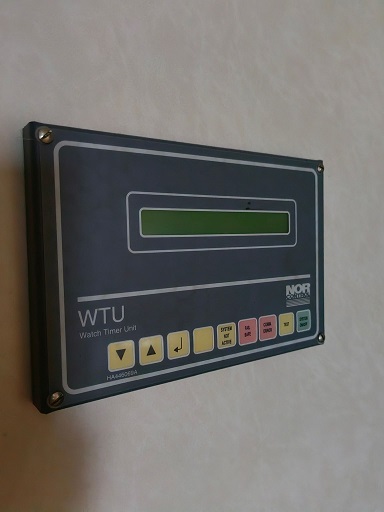
A Bridge Navigational Watch Alarm System (BNWAS) is an automated monitoring system designed to monitor bridge watch activity and detect operator disability that could lead to marine accidents. The system monitors the physical awareness of the Officer of the Watch (OOW) and automatically alerts the Master or qualified back-up officers if the watchkeeper fails to acknowledge system prompts within strict, predefined intervals.
1. Statutory Framework: SOLAS Chapter V and IMO Resolution MSC.128(75)
The mandatory carriage requirements for BNWAS are codified under Regulation 19.2.2 of Chapter V of the International Convention for the Safety of Life at Sea (SOLAS). Performance standards and operational benchmarks are governed by IMO Resolution MSC.128(75) and IEC Standard 62616.
• Cargo ships ≥ 150 GT and all passenger ships constructed on or after July 1, 2011 — fitted at newbuilding delivery;
• Existing passenger ships regardless of size — not later than the first survey after July 1, 2012;
• Existing cargo ships ≥ 3,000 GT — not later than the first survey after July 1, 2012;
• Existing cargo ships 500–2,999 GT — not later than the first safety equipment survey after July 1, 2013;
• Existing cargo ships 150–499 GT — not later than the first safety equipment survey after July 1, 2014.
Under IMO Circular MSC.1/Circ.1474, the BNWAS must remain in active operation throughout the entire voyage, from berth to berth. The physical presence of the Master, additional navigation watchkeepers, or a licensed marine pilot during marine pilotage transfers does not permit deactivating the system! Engagement of the BNWAS prior to departure must be formally entered into the official Deck Log Book.
2. Operational Timing and the Cascading Alarm Sequence
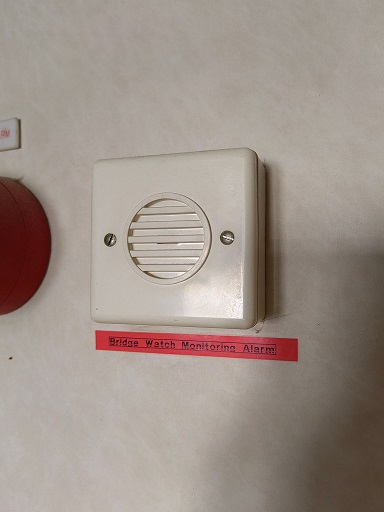
The functional principle of BNWAS mirrors the machinery space dead man alarm, running on a continuous countdown cycle:
3. Acknowledgment Methods, Reset Push-Buttons & Motion Sensors
To restart the dormant period countdown, the OOW activates an approved reset function. Under IMO Res. MSC.128(75), reset facilities are categorized into physical contact devices and automated sensors:
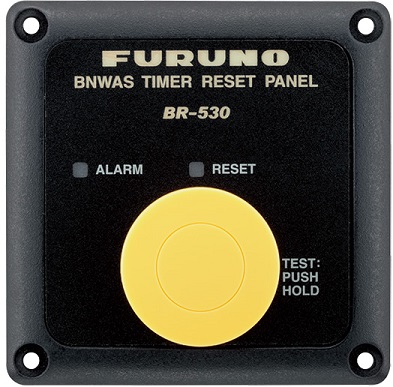
- Physical Push-Buttons: Positioned at the primary steering station, main conning console, radar/ARPA display, ECDIS, chart table, and within weatherproof enclosures (minimum IP56) on both bridge wings;
- Passive Infrared (PIR) Motion Detectors: Detect physical movement of the watchstander within primary lookout and control sectors. Sensors must be carefully calibrated to avoid false resets from vibrating sun blinds or rolling movements in seaways;
- Navigation Equipment Interfacing: The standard permits resetting the timer via genuine operational interactions with integrated equipment (such as adjusting radar gain, altering course on the autopilot, or tuning ECDIS range). Incidental mouse clicks are frequently restricted by software to prevent semi-conscious acknowledgments.
Attempting to bypass the system by jamming, taping, or mechanically weighing down reset buttons is strictly prohibited. BNWAS circuitry incorporates fail-safe continuous contact detection: if a button remains depressed continuously, the system registers a hardware fault and activates an immediate alarm. Such practices are classified by Port State Control (PSC) as major non-conformities under the ISM Code.
4. Operating Modes and the Prohibition of “Automatic” Mode
BNWAS specifications historically incorporated three selectable operating modes:
| Operating Mode | Functional Logic | Current Statutory Status |
|---|---|---|
| Automatic | The BNWAS activates automatically when the heading or track control system (autopilot) is engaged, and deactivates when hand steering is engaged. | PROHIBITED by IMO Circular MSC.1/Circ.1474! Hand steering does not eliminate the risk of watchkeeper incapacitation or distraction. |
| Manual ON | The system operates continuously regardless of whether the ship is hand steered or navigating on autopilot, day or night. | MANDATORY operational state throughout the voyage (“berth to berth”). |
| Manual OFF | The system is completely powered down and inactive. | Permitted only when secured alongside a berth, anchored with watch suspended, or in drydock. |
Mode selection and adjustments to the dormant period (3–12 minutes) must be protected by a physical security key or passcode. Access must remain under the exclusive custody of the Master. Watchkeeping protocols and Master notification triggers are governed by company procedures and standing orders detailed in Helmsman Watch & Steering Orders.
5. Emergency Call Function, Power Supply & VDR Interfacing
- Emergency Call Facility: BNWAS consoles feature an immediate distress button. In the event of armed piracy boarding, acute personal illness, or sudden navigational crisis, the watchkeeper activates the Emergency Call—bypassing dormant periods and instantly triggering Stage 2 and Stage 3 alarms;
- Voyage Data Recorder (VDR) Interfacing: System states (including reset timestamps, alarm stage transitions, and mode adjustments) are output via standard NMEA 0183 sentences (
$xxALR) directly into the vessel’s VDR for casualty investigation; - Power Supply Redundancy: The BNWAS is powered from both main and emergency switchboards. In a complete shipboard blackout, internal battery backup must sustain the visual alarm and emergency call functions for at least 6 hours.
6. Port State Control (PSC) Inspection Criteria
| Inspection Item | Auditor Verification Check | Typical Deficiency Recorded |
|---|---|---|
| Active Operating Mode | Verifying switch position while underway or during arrival. | Unit found in “Auto” or “OFF” mode while navigating. |
| Security Key Custody | Confirming the key is retained by the Master, not left in the lock. | Key left permanently in the panel lock, allowing unauthorized override by watch officers. |
| Alarm Stage Cascade Test | Simulating unresponsiveness to test transition from visual to audible, Master’s cabin, and crew areas. | Buzzer in Master’s cabin silenced, muffled with cloth, or disconnected. |
| Bridge Wing Reset Buttons | Testing external push-buttons for corrosion and sealing integrity. | Water ingress into bridge wing buttons causing contact shorting or reset failure. |
| Deck Log Book Entries | Checking records verifying system operational tests prior to departure. | No logbook entries documenting pre-departure BNWAS verification. |
Frequently Asked Questions: BNWAS Operations (FAQ)