
Naval Architecture // Statutory Stability & IMO Standards
Ship Stability Criteria: IMO 2008 IS Code Standards, GZ Curve Geometry, Free Surface Corrections, and Weather Criterion
A comprehensive technical guide to international ship intact stability criteria mandated by the International Maritime Organization (IMO). Exploring initial metacentric height (GM) estimation, GZ curve area integrals, residual dynamic reserves under cargo shifting, and the mathematical verification of the severe Weather Criterion.
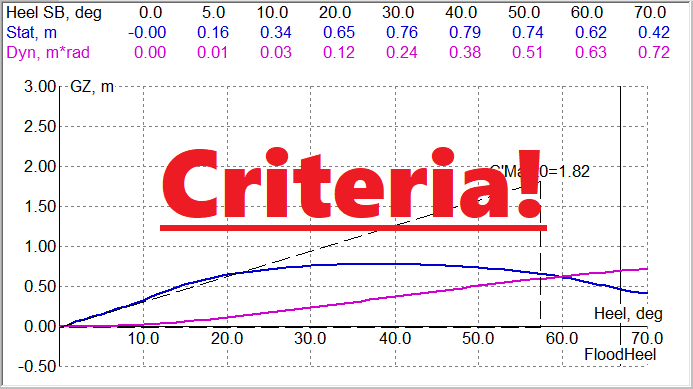
In the conceptual stages of naval architecture, empirical equations derived from systematic model testing of parent hull series are used to estimate metacentric height. These formulas correlate expected transverse stability with primary dimensional parameters: length between perpendiculars (Lbp), molded breadth (B), operational draft (d, as monitored under our under keel clearance calculation guide), and underwater hull fullness (Block Coefficient Cb). Because ship design is an iterative closed-loop process, empirical methods provide the initial baseline.
Once the hull lines plan is finalized, the transverse metacentric height is computed directly from exact hydrostatic particulars:
For standard merchant hulls, the variance between preliminary empirical estimates and final hydrostatics remains within 2–3%. In the vessel’s statutory Stability Booklet, these tabulated hydrostatic particulars form the mandatory baseline for voyage voyage calculations.
Geometry of the Statical Stability Curve: Key Boundary Metrics
Intact stability criteria are evaluated against the vessel’s least favorable operational loading condition (typically the arrival condition with 10% remaining fuel, freshwater, and stores). Fundamental theory can be referenced in Basic Ship Theory.

When analyzing the GZ curve (Reed’s diagram), naval architects and deck officers focus on four critical geometric characteristics:
- Steady Static Heel Angle (θstat): The point of intersection between the righting lever curve (GZ) and the external heeling arm curve (windage, passenger crowding, or cargo shift). It marks the permanent list angle where righting and upsetting moments balance. This angle must never cause the weather deck edge or downflooding openings to submerge.
- Maximum Righting Arm (GZmax) and Corresponding Angle (θmax): The peak resistance of the hull against overturning. A peak displaced toward higher heel angles ensures better survivability in rough following or quartering seas.
- Range of Positive Stability (Angle of Vanishing Stability θv): The angle at which the GZ curve returns to zero. Beyond this point, the righting moment ceases to exist, and the ship capsizes.
- Residual Dynamic Righting Margin: The net vertical and area clearance between the righting lever curve and the heeling arm curve, ensuring sufficient reserve energy to damp out wave-induced roll oscillations.
Dynamic Stability: Curve Areas as Absorbed Energy Reserves
As detailed in our analysis of Ship Dynamic Stability, sudden heeling forces cannot be evaluated through static arm lengths alone. When forces strike instantaneously, stability is governed by the work done by the righting couple.
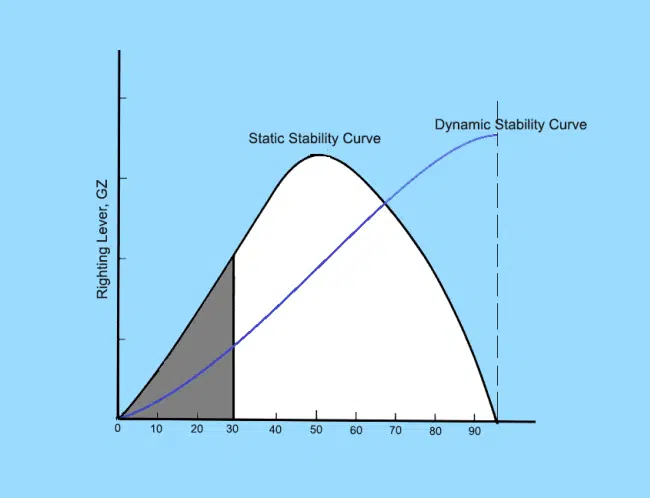
The area under the GZ curve is expressed in meter-radians (m·rad). Physically, this integral quantifies the kinetic energy that the vessel can absorb before overturning when subjected to:
- Violent beam wind gusts coinciding with wave roll peaks;
- Solid bulk grain shifting under the International Grain Code;
- Severe passenger crowding toward the rails on passenger ships;
- High towline snap loads during escort towage.
The net area between the righting lever curve and the heeling lever curve represents residual dynamic stability, which must comply with statutory limits enforced by Flag Administrations and IACS classification societies.
Mandatory IMO Criteria for Cargo Ships (2008 IS Code)
Under IMO Resolution MSC.267(85) — The International Code on Intact Stability, 2008 (2008 IS Code) — every commercial cargo vessel of 500 gross tonnage and above must strictly fulfill the following baseline criteria:
| Stability Parameter | Mandatory IMO Minimum Value | Physical and Safety Objective |
|---|---|---|
| Area under GZ curve up to 30° | Not less than 0.055 m·rad | Guarantees adequate dynamic energy absorption during moderate rolling cycles. |
| Area under GZ curve up to 40° (or downflooding angle θf) | Not less than 0.090 m·rad | Ensures structural resistance against capsizing under severe roll amplitudes. |
| Area under GZ curve between 30° and 40° | Not less than 0.030 m·rad | Prevents steep degradation of righting capability past initial roll angles. |
| Righting arm GZ at or above 30° | Not less than 0.20 m | Ensures a robust physical restoring couple at moderate angles of inclination. |
| Angle of maximum righting arm θmax | Preferably > 30°, but not less than 25° | Prevents premature loss of restoring leverage under dynamic roll excitation. |
| Initial fluid metacentric height GM0 | Not less than 0.15 m (Timber carriers ≥ 0.10 m) | Maintains positive initial upright stiffness, fully corrected for free surface effects. |
In all shipboard loading computations, the metacentric height must be evaluated after deducting the virtual loss due to Free Surface Effects (FSE) across all slack ballast, fuel, and liquid cargo tanks:
GMfluid = GMsolid − ΣδGM.
Submitting uncorrected “solid” GM values violates international conventions and triggers immediate detention during Port State Control (PSC) vetting audits!
The Severe Wind and Rolling Criterion (IMO Weather Criterion)
The Weather Criterion (Factor K) is the central dynamic standard of the IMO 2008 IS Code. It models a hazardous heavy-weather scenario: a vessel listed by steady beam winds rolls into the windward wave trough, and at its maximum roll amplitude (θ1), is struck by a violent wind gust acting in the opposite direction.
The Weather Criterion requires that the residual dynamic righting area (Area b) must equal or exceed the dynamic heeling area caused by the gust (Area a):
If K < 1.00, the voyage cannot legally commence, as the ship’s dynamic righting energy is insufficient to survive sudden squalls in rough seas.
The Critical Role of the Downflooding Angle (θf):
When integrating areas under the GZ curve, integration must terminate at the downflooding angle (θf) if it occurs before 40° or 50°. The downflooding angle is the heel angle at which external openings without weathertight closures (cargo hold ventilation louvers, engine casing intakes, unclosed watertight doors) submerge beneath the sea surface. Once downflooding occurs, the vessel transitions into damaged stability, invalidating the intact GZ curve.
Review core hydrostatic theory in Ship Intact Stability and test your knowledge using our interactive online tool Ship Stability Simulator (GZ Curve).