
Naval Architecture // IMO Conventions & Seaworthiness
Ship Load Lines and the Plimsoll Mark: Markings Geometry, Seasonal Zones, Timber Freeboard, and Density Corrections
A comprehensive professional guide to ship load lines under the International Convention on Load Lines 1966 (ICLL 66) and the 1988 Protocol. Exploring marking geometry, statutory freeboard assignment, reserve buoyancy preservation, seasonal geographic zone transitions, Timber Load Lines, and Port State Control compliance.
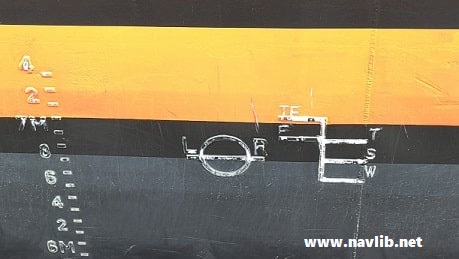
Historical Origin and Purpose: Preserving Reserve Buoyancy
During the nineteenth century, rapid expansion of merchant shipping in the United Kingdom led to widespread overloading of merchant vessels. Over-insured and unseaworthy ships, referred to as “coffin ships”, were routinely dispatched into heavy weather, causing frequent losses of crew lives and cargo.
British Member of Parliament Samuel Plimsoll championed legislation to curb overloading. His campaign produced the Merchant Shipping Act of 1876, making the marking of a maximum load water line—the Plimsoll Mark—mandatory on merchant vessels. International harmonization culminated in the 1930 Load Line Convention, later superseded by the International Convention on Load Lines 1966 (ICLL 66) and its 1988 Protocol.
Freeboard is the vertical distance measured amidships from the upper edge of the deck line down to the assigned load line. The watertight hull volume situated above the working waterline up to the freeboard deck constitutes the ship’s Reserve Buoyancy. Should green water wash over the deck, this reserve volume provides restoring energy, directly preserving intact stability.
Seasonal Zones of the World Ocean
Because water density varies with salinity and sea surface temperature, and wave energy varies with latitude and season, a single static draft limit is impractical. In warm tropical waters with calm sea states, risk to the weather deck is lower, whereas transiting the stormy North Atlantic during winter demands a significantly greater reserve of freeboard.
The Load Line Convention divides world oceans into permanent and periodic seasonal zones:
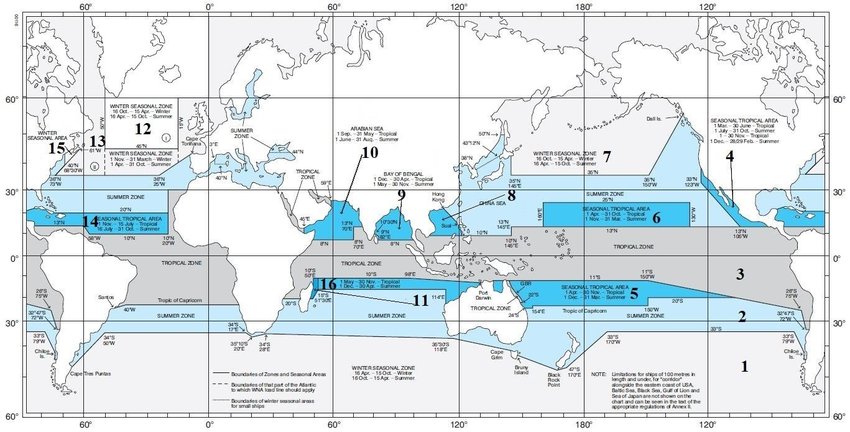
A ship must never be submerged below the draft corresponding to the seasonal zone in which it is navigating. If loading in a Tropical zone and bound for a Winter zone, the departure draft must ensure that daily fuel, lube oil, and water consumption will lighten the vessel to or below the Winter mark prior to crossing into the Winter zone.
Anatomy and Dimensions of Standard Load Line Markings
Load lines must be permanently marked on both port and starboard sides amidships on all vessels of 24 meters in length and greater. Markings are welded onto the hull plating with a thickness of at least 3–5 mm so they remain visible even if the protective coatings degrade. Markings are painted white or yellow against dark topsides, or black against light hull surfaces.
A horizontal bar measuring 300 mm in length and 25 mm in breadth. It is marked amidships on each side of the ship. Its upper edge passes through the point where the continuation of the upper surface of the freeboard deck intersects the outer surface of the shell plating. Assigned freeboards are measured vertically downward from this upper edge.
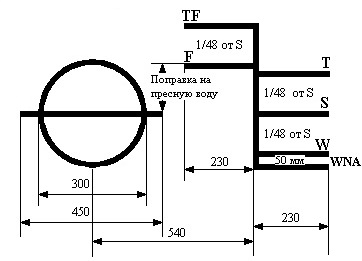
A ring 300 mm in outside diameter and 25 mm in thickness, intersected by a horizontal bar 450 mm in length and 25 mm in thickness. The center of the disk is positioned at the exact mid-length between perpendiculars (Lbp). The upper edge of the horizontal line indicates the Summer salt water draft (Summer Load Line — “S”). Initial capital letters flanking the disk indicate the Assigning Authority / Classification Society (e.g., LR for Lloyd’s Register, NV for DNV, BV for Bureau Veritas, AB for American Bureau of Shipping).
A vertical line 25 mm thick located 540 mm forward of the center of the disk, from which horizontal lines measuring 230 mm in length and 25 mm in breadth extend:
- S (Summer): Level with the center of the Plimsoll disk. Primary baseline for assigned salt water freeboard (ρ = 1.025 t/m³).
- T (Tropical): Marked above Summer at a distance equal to 1/48 of the Summer draft.
- W (Winter): Marked below Summer at a distance equal to 1/48 of the Summer draft.
- WNA (Winter North Atlantic): Marked 50 mm below Winter. Mandatory for all vessels of 100 meters in length and under navigating north of latitude 36°N during winter months. For vessels over 100 meters, WNA coincides with Winter.
- F (Fresh Water): Marked above Summer by the Fresh Water Allowance (FWA), representing immersion in fresh water (ρ = 1.000 t/m³).
- TF (Tropical Fresh Water): Marked above Tropical by an amount equal to FWA.
Water Density Adjustments: FWA and DWA Formulas
When a vessel moves from open sea salt water into fresh river or brackish harbor water, its draft increases due to the reduction in water density. The permitted deeper loading compensates for this physical density drop:
The statutory change in draft when moving between standard salt water (ρ = 1.025 t/m³) and fresh water (ρ = 1.000 t/m³):
where Δ is Summer salt water displacement (metric tons), and TPC is tons per centimeter immersion.
The permitted additional immersion when loading in dock water of intermediate density (ρdock):
If harbor water density is 1.010 t/m³, the ship may legally submerge its Summer mark by the calculated DWA. Upon entering open sea water of 1.025 t/m³, the vessel will rise to float exactly on its Summer line. Compute density corrections via our DWA / FWA Calculator Online.
Timber Load Lines and the 2011 TDC Code
Vessels engaged in the carriage of timber deck cargoes can be assigned special Timber Load Lines granting a reduced freeboard (greater permissible draft).
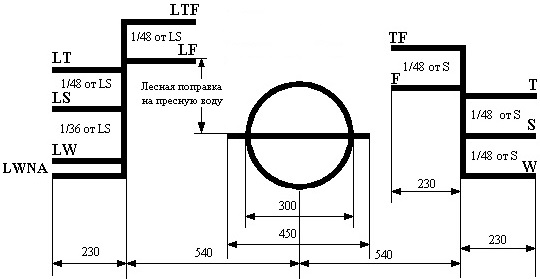
Why are timber deck carriers permitted smaller freeboard? A solid, securely lashed deck timber cargo provides buoyancy and shields weather deck hatch covers from direct sea impact, effectively contributing to reserve buoyancy.
To utilize Timber Load Lines, vessels must strictly comply with the Code of Safe Practice for Ships Carrying Timber Deck Cargoes (2011 TDC Code, IMO Res. A.1048(27)):
- The vessel must feature a forecastle of at least standard superstructure height;
- Double bottom tanks within the midship half-length must have watertight longitudinal divisions to reduce free surface effects;
- Lashing arrangements must withstand transverse acceleration, and initial metacentric height GM throughout the voyage—accounting for water absorption and potential ice accretion—must not be less than 0.10 m.
Timber markings are positioned 540 mm abaft the center of the disk and are prefixed with “L”: LS (Lumber Summer), LT (Lumber Tropical), LW (Lumber Winter), LWNA, LF, and LTF.
International Load Line Certificate and Port State Control
Every compliant vessel is issued an International Load Line Certificate by its Flag Administration or Recognized Organization (RO). It remains valid for up to 5 years, subject to mandatory annual surveys.
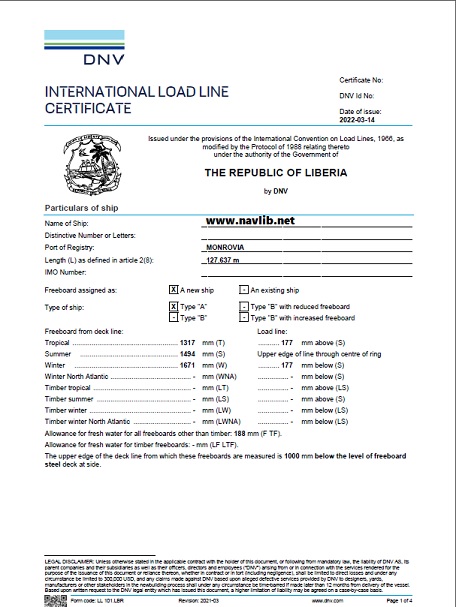
The certificate records the statutory freeboard assignments, deck line location, and fresh water allowance. Any structural alteration affecting hatch coamings, freeing ports, deadlights, or watertight closures voids the certificate.
During Port State Control (PSC) inspections, surveyors verify that the marks remain visible and that the vessel is not overloaded. If a vessel is submerged beyond its permitted seasonal line after correcting for density, it faces immediate PSC detention, potential prosecution of the Master, and mandatory offloading of cargo at the owner’s expense.
Frequently Asked Questions (FAQ)
Statutory Load Line Documents & Reference Library (PDF)
Download official English statutory instruments, consolidated conventions, and industry loss prevention guides:
Deck Cargo
Carefully to Carry: Timber Deck Cargoes (Loss Prevention Guide)
Original Treaty
International Convention on Load Lines 1966 (English Text)
Consolidated Text
Load Lines: Consolidated Edition 2018 (IMO Publication)
MIN 560 (M)
MIN 560 (M): Load Line Convention 1966 & Protocol 1988 Amendments