
SOLAS Convention // Shipmaster’s Statutory Documentation
What Is a Continuous Synopsis Record (CSR): Structure, Amendments & Shipmaster’s Checklist
Put simply, the Continuous Synopsis Record (CSR) is an official, unbroken onboard history of a merchant vessel. Issued from the day of delivery and maintained throughout the ship’s entire operational life until scrapping, it serves as a transparent statutory logbook. When Chapter XI-2 (Special Measures to Enhance Maritime Security and the ISPS Code) was adopted into the SOLAS Convention, Regulation 5 of Chapter XI-1 was introduced simultaneously, making the CSR mandatory for all passenger ships and cargo vessels of 500 gross tonnage (GT) and upwards engaged on international voyages.
1. Purpose and Maritime Security Objectives of the CSR
The International Maritime Organization (IMO) established the Continuous Synopsis Record to eliminate corporate anonymity in global shipping, enhance maritime security, and deter unlawful acts at sea.
Even if a vessel changes registered owners, bareboat charterers, technical ISM managers, Flag States, or Classification Societies a dozen times over a 25-year career, Port State Control (PSC) officers and security authorities can inspect the sequential CSR file on board to trace every entity responsible for the ship at any given point in time.
2. Contents of the Continuous Synopsis Record: 15 Mandatory Entries
Under SOLAS Chapter XI-1, Regulation 5 and IMO Resolution A.959(23), every CSR document (Form 1) must contain the following fifteen standardized entries:
| No. | CSR Entry Field | Description & Onboard Cross-Verification Source |
|---|---|---|
| 1 | Flag State | Name of the State whose flag the ship is entitled to fly. |
| 2 | Date of Registration | The date on which the ship was registered with that Flag State. |
| 3 | Ship’s Identification Number | Permanent 7-digit IMO Number in accordance with SOLAS Regulation XI-1/3 (never changes across flags or owners). |
| 4 | Name of Ship | Current official name of the vessel as shown on the Certificate of Registry. |
| 5 | Port of Registry | Home port where the vessel is registered, matching stern markings and registry certificates. |
| 6 | Registered Owner(s) | Full legal name and registered address(es) of the ship’s registered owner(s). |
| 7 | Registered Owner ID Number | Unique IMO Registered Owner Identification Number introduced to prevent beneficial ownership opacity. |
| 8 | Bareboat Charterer(s) | Name and registered address(es) of the bareboat charterer(s), if applicable (marked N/A if not under bareboat charter). |
| 9 | ISM Operating Company | Name of the Company as defined in SOLAS Regulation IX/1, its registered address, and the address(es) from where it carries out safety management activities. |
| 10 | Company ID Number | Unique 7-digit IMO Company Identification Number (must match the number stated on the DOC and SMC). |
| 11 | Classification Society | Name of all Classification Societies with which the ship is classed. |
| 12 | DOC Issuing Authority (ISM) | Name of the Administration, Contracting Government, or Recognized Organization (RO) that issued the Document of Compliance (or Interim DOC), plus the auditing body if different. |
| 13 | SMC Issuing Authority (ISM) | Name of the Administration, Contracting Government, or RO that issued the Safety Management Certificate (or Interim SMC), plus the auditing body if different. |
| 14 | ISSC Issuing Authority (ISPS) | Name of the Administration, Contracting Government, or Recognized Security Organization (RSO) that issued the International Ship Security Certificate (or Interim ISSC), plus the auditing body if different. |
| 15 | Date of Ceasing Registration | The date on which the ship ceased to be registered with that State (completed upon flag transfer or decommissioning). |
3. How CSR Amendments Work: Form 2 and Form 3
When a newbuilding is delivered from the shipyard to its first owner, only a single document exists in the file—CSR Document No. 1—containing baseline details across all 15 entries.
Suppose three years later the vessel is sold to a new owner who decides to transfer class to a different Classification Society. First, the new owner updates the Certificate of Registry and obtains new Class certificates. Immediately afterward, the Company must apply to the vessel’s Flag State Administration for the issuance of the next sequential record—CSR Document No. 2.
While administrative portals vary by Flag State (most registries now process applications electronically), every amendment submission requires two standardized IMO forms:
Form 2: Amendments to the Continuous Synopsis Record
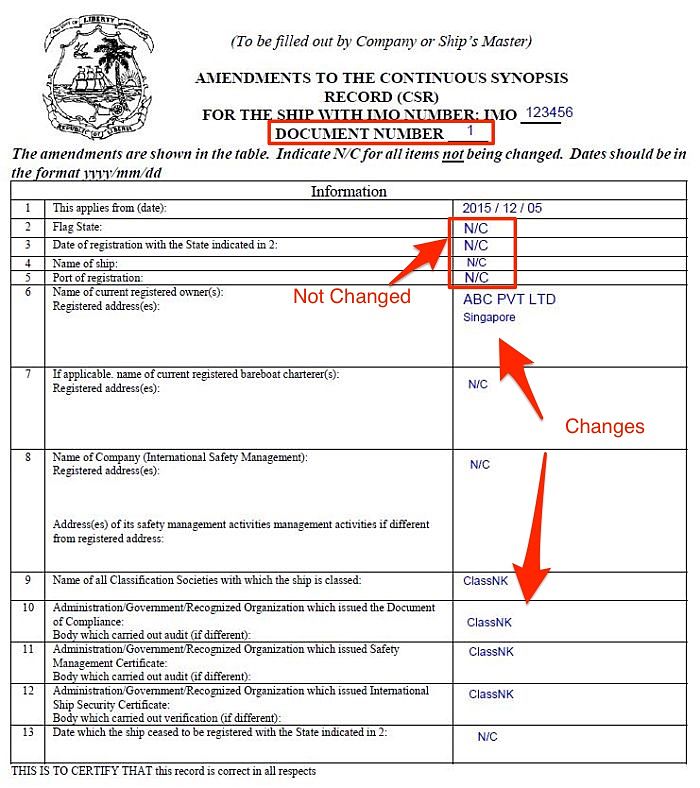
The Amendment Page (Form 2) mirrors the 15-row structure of the primary CSR. When submitting an amendment, the Company enters new information only in the specific rows that have changed (for example, the new owner in rows 6–7 and the new Classification Society in row 11). All unaffected rows must be marked N/C (No Change). The header identifies the exact CSR sequence number to which the amendments apply.
Form 3: Index of Amendments
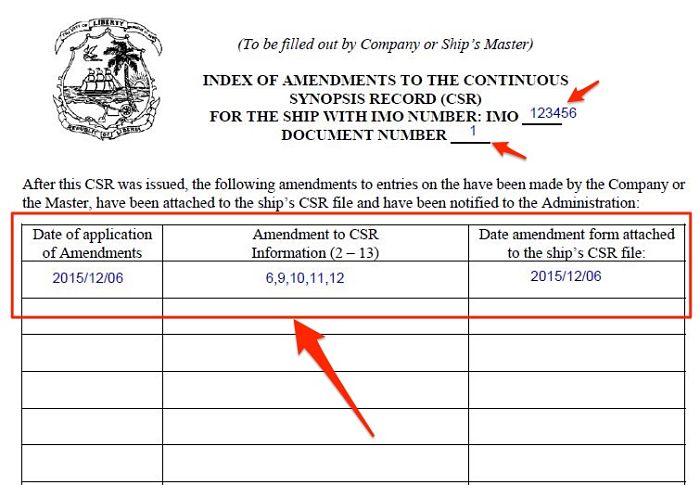
Whenever Form 2 is completed for a CSR document, the Index of Amendments (Form 3) must also be updated and attached. Form 3 serves as a chronological summary table listing the amendment date, sequential number, and the specific CSR entry numbers modified (e.g., Amendments to entries 6, 7, 11).
Based on the submitted application and attached Forms 2 and 3, the Flag Administration issues a fresh original certificate designated as CSR Document No. 2. Every subsequent modification—whether a change of ISM manager, RSO, port of registry, or Flag State—generates the next consecutive number (CSR No. 3, No. 4, and so forth).
Blank CSR Document (Forms 1, 2 & 3)
Complete fillable/printable IMO Continuous Synopsis Record package including the primary CSR Form 1, Amendment Form 2, and Index Form 3 for your ship’s statutory file.
4. Shipmaster’s Checklist: 5 Mandatory Verifications On Board
During command handover and prior to port arrival, the Shipmaster must audit the CSR binder against five essential compliance criteria:
Cross-check all 15 items on the latest CSR against active ship certificates. Registered owner and port of registry must match the Certificate of Registry; the ISM Company name, address, and IMO Company ID must match the DOC and SMC; the Classification Society must match the Class Certificate; and the security issuing authority must match the ISSC.
If any shipboard details have changed (for example, a new RSO issued the ISSC) while the onboard CSR still displays previous details, the Master must contact the Company immediately to verify the latest CSR sequence number.
Under IMO Resolution A.959(23), the Flag State Administration is granted up to 3 months from the application date to issue the updated CSR. During this interim window, signed copies of the submitted Amendment Form (Form 2), Index (Form 3), and Flag State acknowledgment receipt must be kept on board. Presenting this application file to PSC officers prevents deficiencies within the 3-month grace period.
A fundamental rule of SOLAS XI-1/5 is that previous CSR originals must never be removed, discarded, or retained ashore when ownership or flags change. If the current certificate is CSR No. 8, all seven preceding originals—CSR No. 1 through CSR No. 7—must be filed sequentially in the onboard binder.
Every superseded CSR document (No. 1 through No. 7 in our example) must have its corresponding completed Amendment Page (Form 2) and Index of Amendments (Form 3) attached, documenting the exact transition to the next certificate. The latest active certificate (CSR No. 8) remains without a completed Form 2 until a new modification occurs (though blank Forms 2 & 3 may be kept ready in the binder).
The Master must verify that changes recorded on Form 2 attached to CSR No. 6 (e.g., a change of Classification Society) are accurately reflected in the printed text of CSR No. 7. Clerical errors by Flag Administrations are rare, but if discovered during a PSC inspection, the Master is held accountable for failing to report the discrepancy.
5. Common PSC & SIRE 2.0 Inspector Questions on the CSR File
Port State Control inspectors and SIRE 2.0 vetting auditors routinely examine the CSR file at the start of document verification. Below are the most common audit questions and model Master responses:
Model Master Response: “CSR numbering never resets upon flag transfer. The previous Flag State closed its final document by completing Entry 15 (Date of ceasing registration) and forwarded copies to our new Flag Administration. Our onboard binder contains the complete unbroken sequence from CSR No. 1 under the original flag through to our current CSR under the present flag.”
Model Master Response: “No, sir. Under IMO Resolution A.959(23), the Flag State has up to 3 months to issue the updated CSR No. 6. Here are the signed Amendment Form 2 and Index Form 3 attached to CSR No. 5, along with the Flag Administration’s official receipt dated [Date], confirming we are well within the statutory 3-month issuance period.”
Model Master Response: “If any historical CSR is lost or damaged, the Company must formally apply to the specific Flag Administration that originally issued that numbered document to obtain an official Certified True Copy, which is then inserted into its exact chronological position in the onboard file.”
Never file uncertified drafts, loose notes, or unrelated correspondence inside the official CSR binder. When a vessel is sold for recycling (scrapping) or permanently converted into a stationary storage unit outside SOLAS trading, the final CSR document is closed via Entry 15 upon deregistration. Review your complete statutory folder in Ship’s Business: 10 Documents Every Master Must Know.
Frequently Asked Questions on Continuous Synopsis Records (FAQ)