
Vessel Pilot Card & Master/Pilot Information Exchange (MPX): The Professional Mariner’s Guide
Piloted navigation through restricted fairways, complex archipelagos, and congested harbor basins represents one of the highest-risk phases of any commercial voyage. This comprehensive guide examines the regulatory framework governing the Ship’s Pilot Card, delineates legal responsibilities between the Master and Marine Pilot, explores the operational mechanics of the Master/Pilot Exchange (MPX), and provides an inspection-ready NAVLIB Pilot Card & MPX Automation Template in Excel (.xlsm).
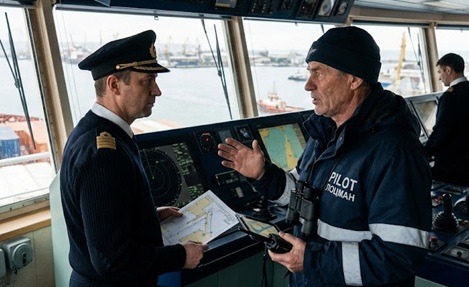
1. What is a Pilot Card? Statutory Mandates and Conventions
A Pilot Card is an operational, voyage-specific document presented to the marine pilot upon boarding. It provides an immediate technical summary of the vessel’s current loading condition, propulsion characteristics, maneuvering capabilities, dimensions, and operational limitations or defects.
The international regulatory framework governing the preparation and presentation of the Pilot Card includes:
- IMO Resolution A.601(15) («Provision and display of manoeuvring information on board ships») — Sets the standard recommended layout, required hydrodynamic data, and protocol for handing the card to the pilot.
- SOLAS 1974 (as amended), Chapter V:
- Regulation 34 (Safe navigation and avoidance of dangerous situations) — Mandates comprehensive berth-to-berth passage planning, covering all pilotage waters.
- Regulation 28 (Records of navigational activities) — Mandates the logging of key navigational events, including the completion of the exchange and pilot card handover.
- ICS Bridge Procedures Guide (6th Edition): Industry standard containing Checklist B3 (Pilot Card) and Checklist B4 (Master/Pilot Information Exchange).
- OCIMF SIRE 2.0 / CDI Regimes: Tanker vetting inspections that scrutinize whether pilot cards reflect dynamic voyage drafts and whether the pilot is properly integrated into Bridge Team Management (BTM).
Port State Control officers (Paris MoU, Tokyo MoU, USCG) and SIRE 2.0 vetting inspectors routinely issue deficiencies for pre-printed, photocopied pilot cards with crossed-out numbers and handwritten pen corrections. A Pilot Card must be generated freshly for each specific port call, displaying exact departure/arrival drafts, calculated air drafts, and actual dock water density.
2. IMO Maneuvering Triad: Pilot Card vs. Wheelhouse Poster vs. Maneuvering Booklet
Under IMO Resolution A.601(15), every merchant vessel must carry three distinct yet complementary sources of maneuvering information:
| Document | Display Location / Handover | Operational Scope & Contents |
|---|---|---|
| 1. Pilot Card | Handed directly to the pilot upon arrival on the navigational bridge. | Dynamic Voyage Document: Real-time fore/aft/mid drafts, calculated trim, dock water density, displacement, current air draft, propulsion status, rudder configuration, anchor shackle counts, and bridge equipment defects. |
| 2. Wheelhouse Poster | Permanently mounted on the bridge bulkhead in plain view. | Permanent Reference Display: Turning circle diagrams (deep water vs. shallow water in ballast and loaded conditions), stopping distances during Crash Stop, emergency maneuvers, windage profiles, and bow/stern thruster performance curves. |
| 3. Maneuvering Booklet | Retained in the chart room within the ship’s statutory library. | Hydrodynamic Sea Trial Dossier: Comprehensive delivery trial telemetry, advanced shallow-water squat tables, directional stability indices, interaction parameters (bank cushion, bank suction, ship-to-ship interaction), and speed loss curves. |
3. Roles, Legal Sign-off, and Bridge Responsibility Division
Who Prepares and Verifies the Card?
In routine shipboard practice, the Officer of the Watch (OOW) or the Second Officer (Navigational Officer) compiles the Pilot Card 2 to 3 hours prior to arriving at the Pilot Boarding Ground.
The navigating officer extracts departure/arrival hydrostatics from the final cargo stowage plan, contacts the Duty Engineer to verify main engine reversing capability, starting air bottle pressures, and steering pump configurations, verifies nautical equipment operability, and inputs these dynamic data points into the card.
The Master audits the documented data, validates its precision, signs the document, and presents it to the pilot during the initial bridge briefing.
Legal Status: Master vs. Pilot
A dangerous misconception exists that once a pilot steps on the bridge, operational and legal liability for the vessel shifts to them. Under maritime law, the division of responsibility is absolute:
«The presence of a pilot on board does not relieve the Master or Officer of the Watch from their statutory duties and overall responsibility for the safety of the ship, crew, and marine environment. The pilot acts exclusively as an expert advisor, providing local fairway, regulatory, and hydrodynamic expertise.»
Understanding «Transfer of the Conn»: During pilotage, the Master delegates the physical conduct of navigation (giving direct helm and engine orders) to the pilot. However, if the pilot’s actions endanger the vessel, the Master is empowered and legally required under the ISM Code (Overriding Authority) to intervene immediately (Override), countermand the pilot’s orders, retake the conn, or request an immediate pilot replacement.
4. Mandatory Structure & Technical Parameters of an IMO-Compliant Pilot Card
In compliance with IMO Resolution A.601(15) and ICS recommendations, a fully compliant Pilot Card incorporates six operational data groups:
Ship name, Call Sign, IMO number, MMSI, Flag state, Year of build, Gross Tonnage (GT), Net Tonnage (NT), Summer Deadweight (DWT), and current Displacement.
Length Overall (LOA), Length Between Perpendiculars (LBP), Extreme Breadth (Beam), Fore/Aft/Mid drafts, Trim, List, Dock Water Density, and maximum calculated Air Draft.
Engine type (slow-speed 2-stroke / medium-speed 4-stroke), MCR output (kW/BHP), Propeller type (FPP / CPP, right-hand or left-hand turning), time required for Full Ahead to Full Astern reversal, and maximum consecutive air starts available.
Engine Telegraph RPM and corresponding speed over ground/through water (kts) for Full, Half, Slow, and Dead Slow Ahead/Astern (ballast vs. loaded). Barred speed range (Critical RPM).
Rudder type (semi-spade, flap/Becker, horn), maximum rudder angle (35°/45°), hard-over time (< 28 sec per SOLAS), Bow/Stern Thruster power (kW/HP) and effective lateral thrust in tonnes.
Port and Starboard anchor cable lengths in shackles/shots, anchor weights. Vital Safety Clause: Clear declaration of any inoperative bridge, steering, or propulsion equipment.
5. Fundamental Differences: Pilot Card vs. Master/Pilot Exchange (MPX)
A frequent operational deficiency on merchant ships is conflating the Pilot Card with the Master/Pilot Exchange (MPX). They serve entirely different functions:
A one-way technical declaration from the ship to the pilot: «Here are our verified dimensions, hydrostatics, engine response times, and current mechanical limitations.»
A two-way collaborative operational dialogue. The pilot provides local fairway intelligence (tidal windows, current sets, berth congestion, limiting depths), while the Master reconciles this against the ship’s maneuvering capabilities.
Core Agenda of the MPX Briefing:
- Passage Plan Reconciliation: Waypoints, wheel-over points, planned transit speeds, and safety corridors (XTD).
- Under Keel Clearance (UKC) & Squat: Calculated dynamic squat margins for shallow-water transit legs based on transit speed and blockage factor.
- Tug Assistance Plan: Number of tugs, bollard pull capacity, conventional vs. escort tugs, make-fast locations (center lead aft, shoulder), and line arrangements (ship’s lines vs. tug lines).
- Berthing & Mooring Strategy: Designated berth, side alongside, mooring line configuration (head lines, stern lines, breast lines, springs), and use of anchors to snub headway.
- Contingency Planning & Abort Points: Abort points, emergency anchorages, and limiting weather criteria (maximum crosswinds, swell, and visibility thresholds).
- Bridge Team Language Protocol: Confirmation of working language (IMO SMCP) and standard helm/engine closed-loop repeat protocols.
NAVLIB Pilot Card & MPX Automation Module (.xlsm)
An automated Microsoft Excel tool designed for shipboard navigating officers. Automates hydrostatics, air draft, and maneuvering speeds while generating an inspection-grade Pilot Card and MPX checklist.
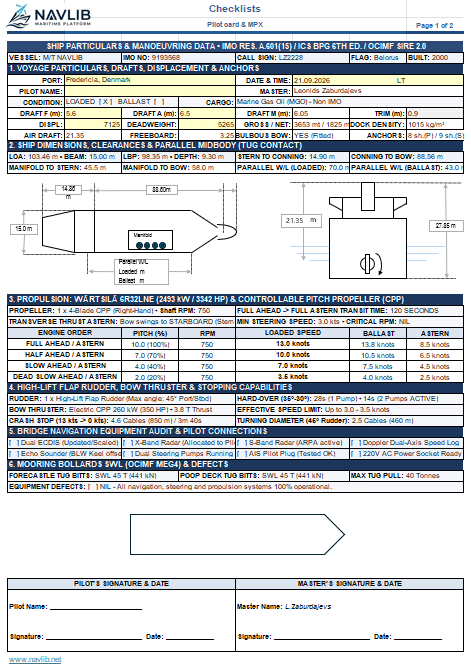
Key Features for Bridge Navigators:
7. Standard Operating Procedure (SOP): From Preparation to Pilot Departure
To satisfy SMS compliance and ensure flawless bridge execution during pilot operations, follow this operational checklist:
- T-2 Hours to Pilot Station: Navigating Officer updates the NAVLIB Pilot Card with arrival drafts, list, trim, dock water density, and equipment status. Two clean hard copies are printed.
- Rigging Pilot Transfer Arrangements: Rig the pilot ladder under the direct supervision of a licensed Deck Officer in strict accordance with SOLAS Chapter V, Regulation 23 and IMO Resolution A.1045(27). Ensure lifebuoy with self-igniting light, heaving line, and manropes are rigged.
- Receiving Pilot: The duty officer receives the pilot at the embarkation point, confirms safe boarding via VHF to the bridge, and escorts the pilot directly to the wheelhouse.
- Master/Pilot Introduction & Handover: The Master welcomes the pilot, hands over the signed Pilot Card, points out the Wheelhouse Poster, and draws immediate attention to any propulsion or steering peculiarities.
- Conducting the MPX Briefing: Master and Pilot execute the MPX checklist, verifying fairway speeds, abort points, and tug securing configurations. Both parties sign the MPX acknowledgment form.
- Deck Logbook Documentation: The OOW immediately enters into the official deck logbook:
- «Pilot Mr. [Name] embarked at [Time] hrs»;
- «Master/Pilot Information Exchange completed. Pilot Card handed over»;
- «Conn handed over to pilot under Master’s supervision at [Time] hrs».