
Chemical Tankers // Cargo Operations & Safety
Carriage of Inhibited Cargoes on Chemical Tankers (IBC Code 15.13): Certificate of Protection, Oxygen Trap & Voyage Control
The marine transport of reactive monomers (such as styrene, acrylic acid, methyl methacrylate, and vinyl acetate) is one of the highest-risk operations on chemical tankers. Statutory handling requirements are governed by Chapter 15 of the International Bulk Chemical Code (IBC Code, Section 15.13 — Cargoes protected by additives), cross-referenced in Column “o” of the Chapter 17 table for each applicable product. This guide examines the chemistry of runaway polymerization, mandatory Inhibitor Certificate items, the oxygen-dependent inerting trap, and key inspection focus areas under CDI and SIRE 2.0.
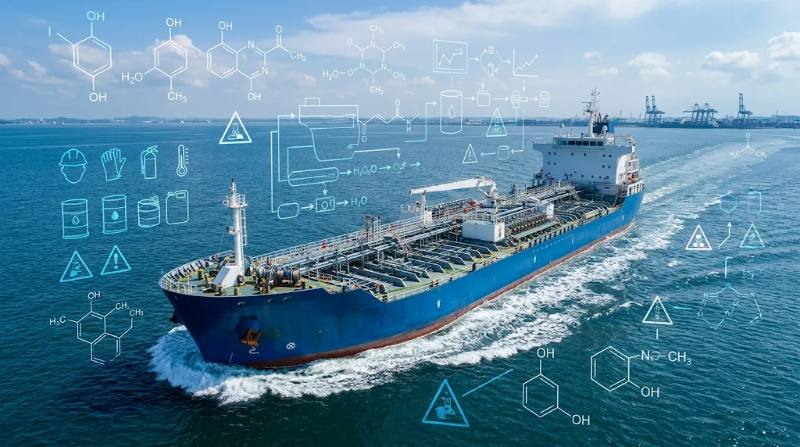
1. Chemical Hazard: Why Monomers Undergo Explosive Polymerization
Inhibited cargoes are predominantly unsaturated monomers whose molecules contain reactive double carbon bonds. Under external or internal triggers, these molecules link together into long polymer chains via a free-radical chain reaction. For broader chemical properties, consult our Tanker Cargo Technical Handbook.
The primary catalysts triggering spontaneous polymerization on board include:
- Elevated Temperature: Solar heating of the weather deck, heat transfer from adjacent heated cargo or bunker tanks (HFO), or prolonged cargo pump recirculation;
- Contamination by Previous Cargo Residues or Water: Traces of acids, alkalis, oxidizers, or moisture resulting from inadequate tank cleaning;
- Contact with Incompatible Materials: Rust (iron oxides), copper, brass, bronze, and light alloys (aluminum/magnesium);
- Inhibitor Depletion: Voyage duration exceeding the additive’s effective lifetime or improper tank atmosphere control.
Polymerization is a strongly exothermic reaction that releases substantial heat. Because liquid monomer inside a cargo tank has low thermal conductivity, heat cannot dissipate rapidly through the hull: cargo temperature escalates exponentially, accelerating the reaction even further. Vapor pressure rapidly overwhelms the venting capacity of Pressure/Vacuum (PV) valves, leading to structural tank rupture, toxic vapor release, and catastrophic explosion.
2. Mandatory Contents of the Inhibitor Certificate (IBC Code 15.13.3)
Under IBC Code Section 15.13.3 and the standardized template in IMO Circular MSC-MEPC.2/Circ.16, the certificate issued by the manufacturer or shipper must explicitly state five mandatory items, which the Chief Officer must verify prior to opening the cargo manifold:
Must specify the chemical name of the inhibitor (e.g., TBC, MEHQ, HQ) and its exact concentration in ppm or mg/kg. Vague statements such as “inhibited as per standard” without numerical concentration values are non-compliant.
Must state clearly Yes or No. If the inhibitor is oxygen-dependent, the certificate must specify the minimum level of oxygen (O2) required in the tank vapor space (as well as the preferred O2 operating range, typically 5–8% by volume) for the additive to remain effective.
Crucial operational detail: the effective lifetime is calculated strictly from the date the inhibitor was dosed at the plant or shore terminal—not from the Bill of Lading date! The stated lifetime (in days or months) must comfortably exceed the planned sea passage plus realistic allowances for weather delays and berth congestion.
Defines the maximum cargo temperature at which the stated lifetime holds valid. Above 25–30 °C, inhibitor depletion accelerates exponentially (every +10 °C increase cuts effective additive lifetime roughly in half or by two-thirds).
Provides explicit emergency instructions from the manufacturer in case of unexpected voyage delays (e.g., diverting to a port of refuge for shore re-dosing, onboard spare inhibitor dosing instructions with exact dosage rates, or emergency discharge).
• Ship’s name, port, and loading berth;
• Trade name and exact technical IBC Code Product Name;
• Expected voyage duration and confirmation of whether spare inhibitor has been supplied on board (Extra inhibitor supplied: Yes/No);
• Issue date, title, name, and signature of the authorized manufacturer/shipper representative.
Important: If additional inhibitor is dosed at the terminal during loading operations, a new, updated Certificate of Protection reflecting the revised concentration must be delivered on board prior to departure.
3. Oxygen-Dependent Inhibitors & The Inerting Trap (IBC Code 15.13.5)
The most dangerous chemical trap on chemical tankers stems from misunderstanding how phenolic inhibitors (such as TBC and MEHQ) function. On their own, these additives cannot terminate polymerization chains—they operate only in conjunction with dissolved oxygen (O2) in the liquid monomer, which acts as the true co-inhibitor.
If a Chief Officer routinely introduces inert gas (nitrogen N2 or flue gas) into a cargo tank containing an oxygen-dependent inhibitor and reduces vapor-space oxygen below the certificate’s minimum threshold (typically 5–8% O2), dissolved oxygen strips out of the cargo into the headspace, deactivating the inhibitor and triggering uncontrolled polymerization.
- On ships required to be inerted under SOLAS Reg. II-2/4.5.5 (tankers of 20,000 DWT and upwards, or vessels with cargo tanks exceeding 3,000 m3): inert gas shall not be applied before loading or during the voyage. Inerting shall only be carried out immediately prior to commencing discharge;
- On ships with cargo tanks of 3,000 m3 or less (exempt from mandatory SOLAS inerting): the cargo is carried under an air atmosphere without inerting. Where inerting is nevertheless required by company or discharge-port rules, inert gas is applied only immediately before discharge;
- Critical Loading Completion Hazard (Line Blowing / Nitrogen Pigging): Never blow shore hoses or shipboard drop lines with compressed nitrogen into the cargo tank through the liquid column when handling an oxygen-dependent inhibited monomer! Rising nitrogen bubbles strip dissolved O2 from the liquid, creating a localized pocket of uninhibited monomer.
4. Common Inhibited Cargoes & Typical Additives
The table below summarizes standard inhibited monomers carried on chemical tankers, their stabilizers, oxygen dependency, and operational hazards:
| Cargo (IBC Product Name) | Typical Inhibitor | O2 Dependent | Key Carriage & Handling Hazards |
|---|---|---|---|
| Styrene monomer | TBC (4-tert-butylcatechol) |
Yes (typically > 5–8% O2) |
Highly sensitive to heat and contact with copper, brass, and rust; prone to forming “popcorn polymer” in vapor/vent lines. |
| Acrylic acid | MEHQ (hydroquinone monomethyl ether) |
Yes (exception: PTZ) |
Freezing point +13 °C. Upon crystallization, inhibitor migrates into the liquid phase, leaving solid crystals completely uninhibited (explosion risk if thawed rapidly!). |
| Methyl methacrylate (MMA) | MEHQ / HQ | Yes | High volatility; monomer vapors condense on cold deckheads, forming hard glassy polymer inside PV valves and flame screens. |
| Vinyl acetate monomer (VAM) | HQ / MEHQ | Yes | Hydrolyzes upon contact with water or moisture to form acetic acid, which accelerates polymerization and attacks tank coatings. |
| Acrylonitrile | MEHQ + Water (0.2–0.5%) |
Yes | Highly toxic (strict TLV gas monitoring, closed loading with vapor return, prohibited adjacent to bunker fuel tanks). |
| Isoprene / Butadiene | TBC | Special Regime (< 0.5% O2 in N2) |
Low boiling point (Isoprene +34 °C); carried under nitrogen padding with strict temperature and pressure control (IBC Code 15.14). |
5. Critical Shipboard Operational Requirements
Commercial inhibitors are high-boiling, non-volatile compounds that remain strictly in the liquid phase. When cargo evaporates inside a tank, the rising vapors contain zero inhibitor. When these vapors condense on cold deckheads, expansion trunks, vent risers, and flame arrester screens, droplets of pure uninhibited monomer polymerize rapidly.
Consequence & Mitigation: Fluffy white (“popcorn polymer”) or hard glassy polymer deposits jam Pressure/Vacuum (PV) valve discs and clog flame screens, risking tank over-pressurization or vacuum collapse. Crew must periodically lift, inspect, and clean PV valves and flame arresters during the voyage, logging every check in the Deck Log Book.
• Inhibited cargoes shall not be stowed in tanks sharing a common bulkhead with heated cargoes or heated bunker tanks (HFO/MGO)—verify segregation using our USCG Compatibility Chart Online;
• Internal tank heating coils must be physically blanked off at both inlet and outlet flanges prior to loading (merely closing steam/thermal oil block valves is insufficient);
• For high-melting-point monomers requiring temperature maintenance (such as acrylic acid at +13 °C), only indirect low-temperature heating (warm water or adjacent tank heat) is permitted to prevent localized overheating at coil walls.
• Daily Monitoring: Measure and record multi-level cargo temperatures (top/middle/bottom at least once daily, and every 6–12 hours in tropical waters or near temperature limits) along with vapor-space O2 readings;
• Early Warning Signs: Unexplained rise in cargo temperature (especially in upper layers), rising tank pressure without external heating, cloudy samples, or white polymer flakes on PV valves;
• Emergency Actions: Immediately activate deck seawater cooling spray over the affected tank, verify PV valve free movement, and notify Owners (DPA) and Charterers to divert to a port of refuge for emergency discharge. Spare onboard inhibitor dosing is used only as a last resort under strict procedure.
Industry best practice (CDI / OCIMF) treats onboard dosing by crew at sea strictly as an emergency contingency—routine dosing should be completed ashore before or during loading. Whenever spare inhibitor is placed on board:
• A dedicated Safety Data Sheet (SDS / MSDS) for the inhibitor itself (many additives are acutely toxic and corrosive) and any required medical antidotes must accompany the drums;
• Dosing must be performed exclusively via closed systems through designated dosing/sampling fittings—never pour inhibitor through an open tank hatch or sounding pipe due to static ignition and toxic vapor exposure risks;
• Following injection, circulate the cargo using the cargo pump to ensure homogeneous mixing throughout the tank.
Initial tank, line, and pump flushing (Pre-wash / Cold Flush) after discharging inhibited monomers must be performed strictly with cold seawater at ambient temperature! For tank cleaning sequences, consult our Tank Cleaning Guide Online.
Introducing hot water or steam into a tank containing residual monomer film immediately triggers polymerization: hard polymer bonds permanently to stainless steel or epoxy coatings, requiring mechanical grinding that damages passive steel layers. Hot washing is permitted only after all monomer traces have been flushed out with cold water.
6. Typical Vetting Observations & Inspector Questions (SIRE 2.0 / CDI / PSC)
During chemical tanker audits, CDI and SIRE 2.0 inspectors closely verify Inhibitor Certificates, physical heating coil blanks, and the Chief Officer’s operational knowledge:
Chief Officer Action: Refuse to commence loading until an amended certificate matching MSC-MEPC.2/Circ.16 is received, and immediately tender a Letter of Protest (LOP) to protect Owners against demurrage disputes.
Best Practice: Effective inhibitor lifetime should exceed planned voyage duration by at least 10–14 days.
Frequently Asked Questions on Inhibited Cargoes (FAQ)