
Fire Safety Systems // Shipboard Damage Control
International Shore Connection (ISC): Flange Dimensions, SOLAS Regulations & Operational Standards
A comprehensive technical guide to the International Shore Fire Connection (ISC): statutory requirements under SOLAS Chapter II-2 Regulation 10 and Chapter 2 of the International Code for Fire Safety Systems (FSS Code), standardized metric flange dimensions, required bolt-and-gasket sets, operating pressure ratings, gangway stowage rules, and Port State Control (PSC) audit criteria.
An International Shore Connection (ISC) is a standardized coupling flange designed to connect a ship’s fire main to external shore-side water supplies or other vessels. Because shore-based fire services utilize diverse national hose couplings (such as Storz, Nakajima, GOST, or British Instantaneous BS 336), the ISC provides a universal, globally identical flange interface ensuring immediate water delivery in any port worldwide.

1. Statutory Mandates: SOLAS Chapter II-2 & FSS Code Chapter 2
The statutory framework governing the carriage and design of international shore connections is codified across international conventions:
- SOLAS Chapter II-2, Regulation 10.2.1.7: All ships of 500 gross tonnage (GT) and upwards must be provided with at least one International Shore Connection;
- Passenger Vessels: Passenger ships carrying more than 36 passengers must be equipped with at least two international shore connections, arranged to ensure rapid deployment to either side of the vessel;
- International Fire Safety Systems (FSS) Code, Chapter 2: Specifies standard engineering dimensions, manufacturing materials, bolt slot arrangements, and gasket test pressures.
The connection flange, fasteners, and attached fittings must withstand an operating pressure of at least 1.0 N/mm² (10 bar / 145 psi). Furthermore, to prevent water hammer and pipeline damage, the linear velocity of water delivered into the vessel’s fire main system should not exceed 5 m/s.
2. Standardized Flange Dimensions (FSS Code Table 2.1)
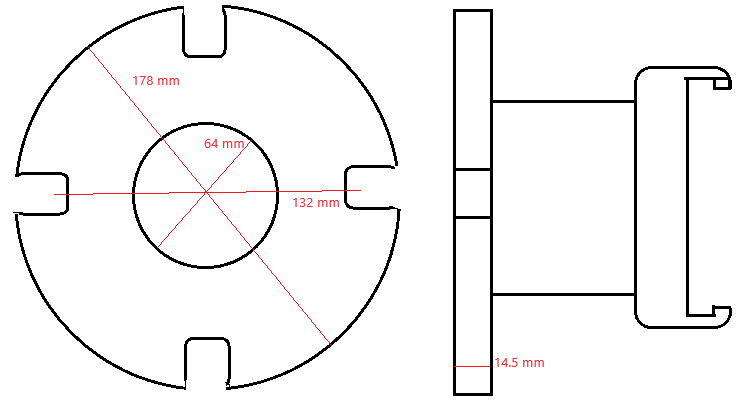
The dimensions of the ISC flange are universally fixed by international regulation. The bolt holes feature open-ended slots cut directly through the outer circumference, enabling rapid securing without disassembling nuts completely:
| Flange Parameter (FSS Code Ch. 2) | Metric Dimension (mm) | Imperial Equivalent (Inches) |
|---|---|---|
| Outside Diameter (OD) | 178 mm | 7.0 inches |
| Inside Diameter (Bore) | 64 mm | 2.5 inches |
| Bolt Circle Diameter (PCD) | 132 mm | 5.25 inches |
| Slots in Flange | 4 holes of 19 mm diameter, equidistantly spaced on PCD, slotted to the flange edge | 4 slots, 0.75-inch diameter |
| Flange Thickness | Minimum 14.5 mm | Minimum 0.57 inches |
| Bolts and Nuts | 4 bolts, each 16 mm diameter by 50 mm length with matching nuts | 4 bolts, 5/8-inch dia. × 2-inch length |
| Washers | 8 flat metal washers (placed under both bolt heads and nuts) | 8 washers |
| Flange Gasket | 1 gasket made of oil- and heat-resistant elastomer (rated to 10 bar) | 1 gasket (OD 178 mm / ID 64 mm) |
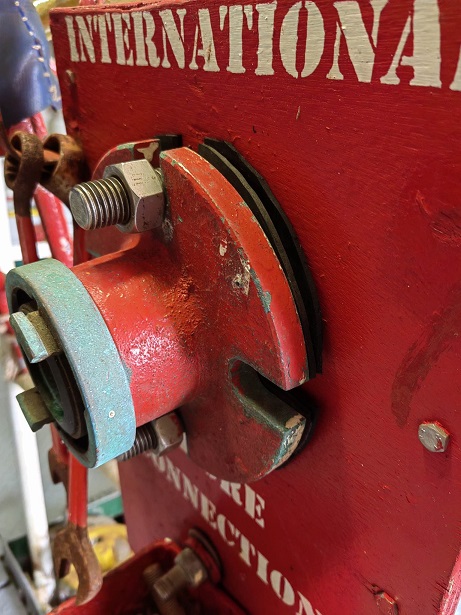
3. Stowage Configurations, Port Berth Practice & Markings
The physical accessibility of the International Shore Connection is among the first safety items evaluated during Port State Control and terminal vetting audits:
- Underway Stowage: At sea, the portable ISC kit is kept in an easily accessible, clearly signed locker, typically within the central Fire Control Station, safety equipment store, or main deck entrance lobby;
- Port Routine (Gangway Deployment): Immediately upon mooring alongside a commercial quay or terminal, the dedicated ISC kit must be positioned on the weather deck in the immediate vicinity of the gangway or accommodation ladder on the working berth side;
- Working Pressure Notice: A permanent bilingual notice (including English) must be displayed adjacent to fire main manifolds and shore connection stations, indicating design limitations (e.g., “FIRE MAIN MAXIMUM WORKING PRESSURE: 10.5 BAR”);
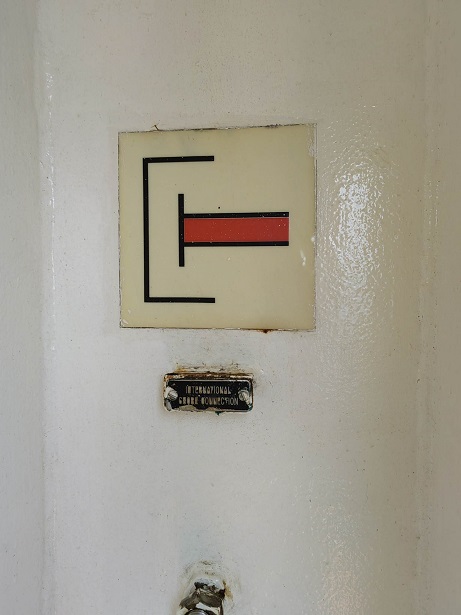
- Fire Control Plan Identification: The exact location of all international shore connections must be indicated on the ship’s official Fire Control Plan using the standardized IMO graphical symbol (IMO Res. A.952(23)). Review required certificates via our Maritime Ship Certificates Registry.
4. Port State Control (PSC) Deficiencies & Crew Readiness
Deficiencies concerning the International Shore Connection regularly appear in PSC detention records under the Paris and Tokyo MOUs:
| PSC Audit Checkpoint | Required Statutory Condition | Typical Deficiency Recorded |
|---|---|---|
| Fastener Completeness | Exactly 4 bolts (M16×50), 4 nuts, and 8 washers present in the box. | Washers missing, bolts heavily corroded, nuts seized on threads. |
| Gasket Condition | Flexible, undamaged elastomeric gasket of matching PCD and diameter. | Gasket hardened, missing, or dried out. Recommendation: Keep at least two fresh spare gaskets in the kit. |
| Spanner Availability | Two correctly sized open-ended spanners (24 mm) stored inside the box. | No tools in the locker; crew must search the engine room for wrenches during fire drills. |
| Shipboard Coupling Pattern | The reverse coupling must mate with the vessel’s hydrants (e.g., Storz, Nakajima). | Coupling incompatible with the vessel’s hydrants following shipyard modifications. |
| Muster List Duty Assignment | A designated crew member assigned in the Muster List to deploy the ISC. | Assigned crew member unable to locate the kit or demonstrate coupling during fire drills. |
• Inspect the ISC locker monthly, verifying that bolts and nuts are lubricated with silicone grease;
• Store the four bolts, nuts, and eight washers in a canvas pouch or sealed tube to prevent loss;
• During routine fire drills, conduct timed coupling tests connecting the ISC to deck hydrants (target completion time: under 3 minutes);
• Review shipboard emergency readiness through formal assessments via our Marine Risk Assessment Online Tool.
Frequently Asked Questions: International Shore Connection (FAQ)