
GMDSS // Life-Saving Appliances & Radar Location
What Is a Search and Rescue Transponder (SART & AIS-SART)? Working Principle, SOLAS Rules & PSC Audits
A Search and Rescue Transponder (SART) is an essential short-range locating device within the Global Maritime Distress and Safety System (GMDSS). While a satellite EPIRB alerts Rescue Coordination Centers globally, the SART is engineered specifically to home rescue vessels and SAR aircraft directly onto a survival craft (lifeboat or liferaft) during the final visual and radar search phase.

1. SOLAS Carriage Requirements and Onboard Stowage
Mandatory carriage and stowage rules for Search and Rescue Locating Devices are prescribed under SOLAS Chapter III, Regulation 6.2.2 and Chapter IV:
- Cargo ships of 300 GT and upwards but less than 500 GT: At least 1 (one) SART or AIS-SART;
- Cargo ships of 500 GT and upwards and all passenger ships: At least 2 (two) SARTs or AIS-SARTs (stowed on opposite sides of the bridge for rapid transfer to survival craft);
- Ro-Ro passenger ships: Sufficient SARTs to provide at least 1 transponder for every 4 liferafts;
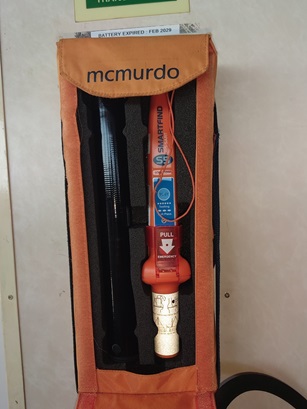
- Vessels fitted with Free-Fall Lifeboats: One SART must be permanently stowed inside the free-fall lifeboat, while the second unit is mounted on the navigation bridge adjacent to the wing doors.
On the bridge, SART units are secured in quick-release mounting brackets near the bridge wing exits so watchkeeping officers can grab them immediately upon abandoning ship. Inside lifeboats and liferafts, dedicated telescopic poles or mounting sockets are provided. Under IMO performance standards, the SART antenna must be mounted at a minimum height of 1 meter above sea level to achieve its rated detection range.
2. Working Principle and X-Band Radar Display Evolution
Unlike an EPIRB, a SART has no automatic hydrostatic release unit (HRU). It must be activated manually by survivors once inside the survival craft by pulling the safety pin and switching the selector to ON.
Upon activation, the unit enters a low-power Standby Mode, listening for radar pulses in the 3-cm X-band frequency range (9.2 to 9.5 GHz). When triggered by an interrogating shipborne or airborne X-band radar pulse, the SART switches immediately to Active Transmit Mode and emits a series of 12 swept-frequency pulses.
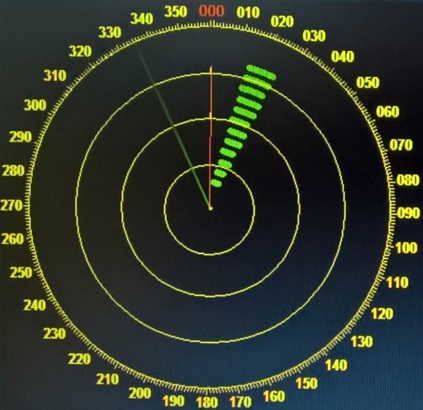
- Long Range (5–10 NM from a ship; up to 30–40 NM from a SAR aircraft): Appears as a radial line of 12 equally spaced dots (blips) extending outward from the survivor’s position. The innermost dot closest to the radar center marks the exact position of the SART!
- Medium Range (approx. 1–2 NM): As the radar beam widens across the transponder, the 12 dots elongate into 12 concentric sector arcs.
- Close Range (less than 0.5–1 NM): The arcs expand into 12 full concentric circles surrounding the radar center, alerting bridge watchkeepers that the survival craft is immediately ahead.
A Radar-SART operates exclusively on 3-cm X-band radars (9 GHz) and is completely invisible on 10-cm S-band radars (3 GHz). Furthermore, during SAR operations, bridge officers must turn off or minimize Anti-Clutter Rain (FTC) and Sea Clutter controls as well as Interference Rejection (IR) on the X-band radar—otherwise, the radar processor will treat the SART’s swept pulses as noise and suppress them from the display!
3. Construction Standards, Battery Endurance & Monthly Testing
IMO performance standards (Resolution MSC.510(105), superseding A.802(19)) mandate rigorous environmental and endurance specifications:
- Rugged Buoyant Housing: Constructed from fiber-reinforced, UV-resistant high-visibility orange or yellow polymer; watertight to a depth of 10 meters for at least 5 minutes, capable of surviving a 20-meter drop into water, and fitted with a buoyant lanyard at least 10 meters long;
- Audio & Visual Activity Indicators: Emits a beep and LED flash every 12 seconds in Standby Mode, accelerating to every 2 seconds when interrogated by an X-band radar (reassuring survivors that a rescue radar is sweeping their craft);
- Battery Capacity: Minimum 96 hours in Standby Mode followed by 8 hours of continuous transmission when interrogated at a 1 kHz pulse repetition frequency across temperatures from -20°C to +55°C. Lithium battery packs carry a 2 to 5-year replacement cycle.
- Verify minimal traffic nearby or keep the test brief (a few seconds) to avoid interfering with surrounding ships;
- Set the ship’s 3-cm X-band radar to a short range scale (1.5 or 3 NM);
- Hold the spring-loaded SART switch in the TEST position while holding the unit on the bridge wing within line-of-sight of the X-band scanner;
- Confirm that both the visual LED and audible buzzer activate properly;
- Observe the X-band radar display to verify the appearance of concentric circles confirming transmitter/receiver integrity;
- Release the switch back to OFF, inspect the battery expiry date label and bracket securing, and record the test in the GMDSS Radio Logbook.
If a SART is inadvertently switched to live ON mode instead of TEST:
1. Switch the SART to OFF immediately;
2. Transmit a VHF DSC Safety Alert on Channel 70;
3. Broadcast a voice Safety Message (SÉCURITÉ) on VHF Channel 16 to all stations stating your vessel name, call sign, MMSI, current position, and explicitly cancelling the false SART transmission.
4. AIS-SART: Modern GNSS Standard vs. Radar-SART
Under SOLAS amendments, vessels may carry an AIS-SART (AIS Search and Rescue Transmitter) as an approved alternative to a Radar-SART. Instead of relying on radar interrogation, an AIS-SART incorporates an internal GNSS (GPS) receiver and broadcasts standard AIS position reports once per minute on VHF AIS channels (161.975 MHz and 162.025 MHz). Nearby vessels see the exact survivor position on their AIS displays, radars, and ECDIS as a dedicated red circle containing an “X” accompanied by the safety text “SART ACTIVE”.
| Feature | Radar-SART | AIS-SART |
|---|---|---|
| Operating Frequency | 9.2 – 9.5 GHz (3-cm X-Band Radar) | 161.975 MHz & 162.025 MHz (AIS Channels 1 & 2) |
| Position Source | None (range and bearing derived by rescue ship’s radar) | Built-in GNSS (GPS) receiver providing meter-level accuracy |
| Bridge Display Presentation | 12-dot / arc / circle radial pattern on X-Band radar only | Red circle-with-cross icon on ECDIS, AIS, and radar overlays + audible alarm |
| Heavy Sea & Shadow Performance | Subject to sea-clutter masking and hull shadow sectors | Superior VHF propagation less affected by wave clutter |
| Transmission Mode | Transponder (transmits only when swept by X-band radar) | Autonomous transmitter (broadcasts GPS packets every 60 seconds) |
IMO Resolution MSC.510(105) — Performance Standards for Search and Rescue Radar Transponders
Official Maritime Safety Committee resolution (adopted 28 April 2022) establishing technical and endurance standards for marine SART units.
5. Common PSC & SIRE 2.0 Inspector Questions on SART & AIS-SART
During Port State Control (PSC) inspections and vetting audits, officers are routinely tested on both equipment readiness and practical SAR radar operation:
SART ACTIVE, triggering a solid red circle-with-cross icon on ECDIS/AIS and an audible alarm. During monthly testing, it transmits SART TEST, displaying a test symbol without generating a distress alert.”
Frequently Asked Questions on SART & AIS-SART (FAQ)