
Maritime Law // Commercial Ship’s Business
What Is a Bill of Lading (B/L)? Legal Functions, Types & Shipmaster’s Rules
To understand the essence of a Bill of Lading (abbreviated as B/L or BoL), look at the origin of its terminology: in commercial law, a “bill” denotes an itemized legal statement of goods, while “lading” (derived from the Old English hladan) means loading cargo onto a vessel. In international maritime trade, the Bill of Lading is the cornerstone commercial and legal instrument governing the carriage of goods by sea, binding the shipper, carrier, and consignee into a transparent chain of custody and financial settlement.
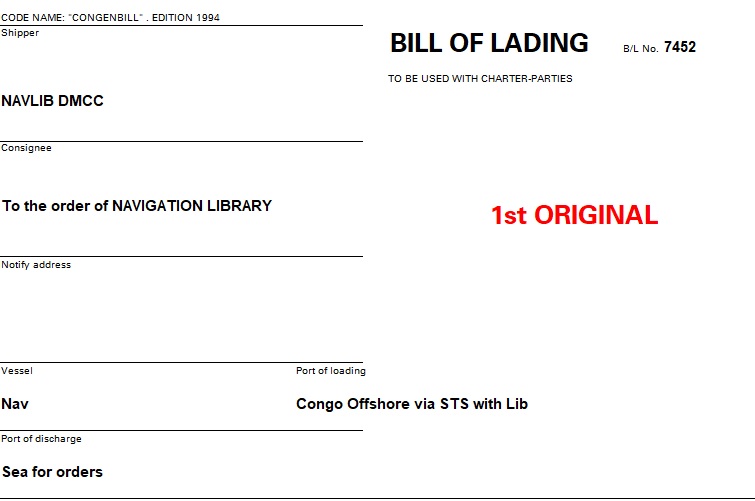
1. Three Fundamental Legal Functions of a Bill of Lading
Many newcomers confuse a Bill of Lading with a simple delivery receipt. Under international maritime law, a classic negotiable Bill of Lading simultaneously fulfills three distinct legal roles:
When signed by the Shipmaster or authorized port agent on behalf of the carrier, the Bill of Lading formally acknowledges that the stated cargo has been received on board in the specified quantity (weight, volume, or package count) and in “apparent good order and condition.” From that moment, custody and legal responsibility for safe carriage rest with the ocean carrier.
While the initial booking contract or Charter Party is concluded prior to loading, the terms and conditions printed on the reverse side of the Bill of Lading govern the legal relationship between the carrier and any third-party endorsee (consignee) to whom the document is subsequently transferred.
This unique characteristic separates the ocean Bill of Lading from air waybills or road consignment notes. Possession of the original Bill of Lading is legally equivalent to constructive possession of the cargo itself. While the ship is underway at sea, cargoes of crude oil, grain, or containers can be bought and sold multiple times simply by endorsing and transferring the original B/L, enabling banks to finance international trade via Letters of Credit (L/C).
For a comprehensive examination of case law, clausing disputes, and carrier defenses under ocean bills of lading, consult Stephen Mills’ authoritative reference Bills of Lading (Stephen Mills) in the NavLib maritime library.
2. Primary Types of Bills of Lading in Shipping Practice
Depending on negotiability, cargo condition at loading, and multimodal logistics structures, Bills of Lading are classified into specific operational categories.
A. By Negotiability and Consignee Designation
| Bill of Lading Type | Consignee Box Wording | Legal Status & Commercial Application |
|---|---|---|
| Straight Bill of Lading | Named consignee only (without “to order”) | Non-negotiable. Cargo must be delivered strictly to the named consignee upon proof of identity (and surrender of the original B/L where required by local law). Cannot be transferred to third parties via endorsement. |
| Order Bill of Lading | “To the order of [Shipper / Bank / Consignee]” | The standard negotiable instrument in global trade. Ownership is transferred to subsequent buyers by endorsing the reverse side and physically delivering the original B/L. Essential for Letter of Credit transactions. |
| Bearer Bill of Lading | “To Bearer” or blank-endorsed Order B/L | Negotiable by physical delivery alone. Any lawful holder presenting the original document may claim the cargo. Rarely used in deep-sea trade due to high theft and loss risks. |
B. By Cargo Condition, Loading Status & Transport Mode
| Bill of Lading Variant | Operational Definition & Practical Function |
|---|---|
| Clean Bill of Lading | Issued without any superimposed clauses declaring defective cargo or packaging condition. Confirms goods were loaded in apparent good order. Commercial banks generally accept only Clean B/Ls under Letters of Credit. |
| Claused / Dirty / Foul B/L | Contains explicit remarks inserted by the Master or Chief Officer noting actual defects observed during loading (e.g., “12 bags torn and slack,” “Heavy rust staining,” or “Wet prior to shipment”). Protects the shipowner against false damage claims at discharge. |
| Shipped on Board B/L | Certifies that the goods have been physically loaded aboard the named ocean vessel, bearing a specific Shipped on Board Date. |
| Received for Shipment B/L | Issued by a port terminal or carrier agent upon receiving cargo into shore custody prior to vessel arrival; later converted into an onboard B/L via a dated “On Board” notation. |
| Master B/L (MBL) vs. House B/L (HBL) | MBL is issued by the actual ocean carrier to a freight forwarder (NVOCC). HBL is issued by the freight forwarder to individual underlying shippers for consolidated LCL container shipments. |
| Through B/L & Combined Transport B/L | Covers multi-leg voyages involving transshipment between vessels or multimodal door-to-door transport combining sea, rail, and road legs under a single contract. |
| Switch Bill of Lading | A second set of originals issued in exchange for the first set (which must be surrendered and cancelled in full) during mid-voyage commodity trading to conceal the original supplier’s identity from the end buyer. |
3. Set of Three Originals (3/3) and Electronic Bills of Lading (eB/L)
By long-standing maritime custom, Bills of Lading are executed in a Set of Three Originals (First Original, Second Original, Third Original) alongside several non-negotiable copies for ship files, agents, and customs authorities. Historically, merchants dispatched originals via separate mail packets so trade would not halt if one ship sank.
Every original carries the standard attestation clause: “In witness whereof the Master or Agent of the said Vessel has signed three (3) Bills of Lading all of this tenor and date, any one of which being accomplished, the others to stand void.” Accordingly, once cargo is lawfully delivered at the discharge port against one presented original, the remaining two originals automatically become null and void. For this reason, financing banks always demand presentation of a Full Set (3/3 Originals).
Electronic Bills of Lading (eB/L)
Paper Bills of Lading frequently lag behind modern vessel transit speeds—a tanker or container ship may reach its discharge port in three days while paper originals remain stuck in banking courier chains for two weeks, incurring costly demurrage. To eliminate paper delays, the International Group of P&I Clubs (IG P&I) has approved secure digital eB/L platforms including Bolero, essDOCS, WaveBL, CargoX, and ICE Digital Trade.
- Key Advantages of eB/L: Instantaneous global title transfer via cryptographic signatures, immunity to physical forgery, and elimination of international courier expenses;
- Operational Constraints: Requires all chain participants (shippers, carriers, banks, and receivers) to be onboarded onto the same approved digital registry and local port customs to recognize electronic title transfers.
4. Governing International Conventions & Mandatory B/L Entries
Carrier liability limits and statutory exemptions are governed by international conventions incorporated via the Paramount Clause on the Bill of Lading:
- Hague Rules (1924) & Hague-Visby Rules (1968/1979): The dominant global liability regime for charterparty and liner bills, establishing package/weight limitation ceilings and nautical fault defenses;
- Hamburg Rules (1978): A stricter UN carrier liability framework ratified by several African, Middle Eastern, and Latin American trading nations;
- US COGSA (1936): Compulsorily applies to all bills of lading covering shipments to or from United States ports;
- Rotterdam Rules: Modern UN convention designed to harmonize multimodal door-to-door carriage and electronic transport records.
Whether issued on a liner form (CONLINEBILL) or a charterparty form (CONGENBILL), every Bill of Lading contains standardized details cross-checked against the ship’s Cargo Manifest:
- Full legal names and addresses of the Shipper, Consignee, and Notify Party;
- Vessel name, flag, Port of Loading, and Port of Discharge;
- Commodity description, leading shipping marks, number of packages, gross weight/volume, and IMDG Code UN number/class for hazardous cargoes;
- Freight payment terms: Freight Prepaid or Freight Payable as per Charter Party / Collect;
- Place and date of issue, number of originals signed, and signature of the Master or authorized agent.
5. Shipmaster’s Practice: Signing Rules & P&I Audit Scenarios
Mishandling Bills of Lading is one of the fastest ways to prejudice a shipowner’s P&I Club insurance cover. Below are three critical operational scenarios tested during commercial audits and Master’s command assessments:
Required Action: 1) Immediately tender a formal Letter of Protest (LOP); 2) Demand that ship’s figures be inserted on the B/L; 3) If shippers refuse, clause the B/L prior to signing: “Ship’s figures: 49,450 MT. Signed under protest as per Master’s LOP dated [Date]” and alert Owners and the P&I Club immediately.
Master’s Protocol: The Master has no authority to accept an LOI independently. Discharge may commence only upon receiving explicit written instructions directly from the Registered Owners (not merely time-charterers) confirming approval of a bank-countersigned LOI.
Never sign blank Bills of Lading, never backdate (antedate) a Bill of Lading to match an expiring Letter of Credit—antedating constitutes criminal fraud and voids all P&I protection—and always issue a written Letter of Authorization specifying strict clausing limits whenever port agents are authorized to sign B/Ls on your behalf. Review essential command paperwork in Ship’s Business: 10 Documents Every Master Must Know.
Frequently Asked Questions on Bills of Lading (FAQ)