
Shipboard Documentation // MARPOL Annex I & Oil Handling
A Guide to Correct Entries in the Oil Record Book (INTERTANKO): Practical Manual for Parts I & II
The definitive operational manual published by the International Association of Independent Tanker Owners (INTERTANKO) for compliant record-keeping in the Oil Record Book. Contains standardized logging instructions for machinery space operations (ORB Part I — all ships) and cargo/ballast operations (ORB Part II — oil tankers), analyzing common mistakes, item codes, and compliance standards enforced by Port State Control (PSC) and the United States Coast Guard (USCG).
About the Handbook: Protecting Bridge & Engine Officers from Severe Liabilities
Although maintaining an Oil Record Book (ORB) has been a mandatory requirement under MARPOL Annex I for decades, it remains the prime focal point of Port State Control (PSC) inspections, vetting audits, and United States Coast Guard (USCG) boardings. Discrepancies in dates, unreconciled daily sludge generation calculations, missing signatures, or inaccurate letter codes are frequently treated by authorities not as clerical errors, but as intentional fraud (“False Records Claims”), risking immediate vessel detention and criminal prosecution of the Chief Engineer and Master.
The INTERTANKO publication “A Guide to Correct Entries in the Oil Record Book” is acknowledged across the maritime industry as the benchmark for entry accuracy. The publication spans two volumes: Part I (Machinery Space Operations for every ship of 400 gross tonnage and above) and Part II (Cargo and Ballast Operations for oil tankers of 150 gross tonnage and above). The authors cross-reference entries against the International Oil Pollution Prevention (IOPP Certificate) Form A and B supplements, harmonizing tank naming conventions and providing field-proven logging templates for every shipboard event.
When preparing commercial tonnage for statutory audits, senior officers should also review our practical guide on Mandatory Ship Certificates, verify bilge water discharge logs, review the Ballast Water Record Book Assistant, and consult the MARPOL Annex II Calculator.
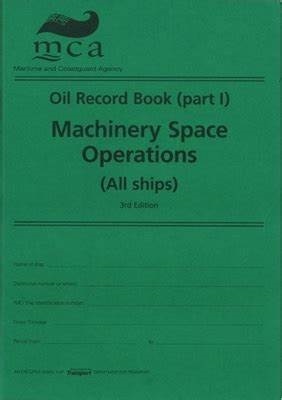
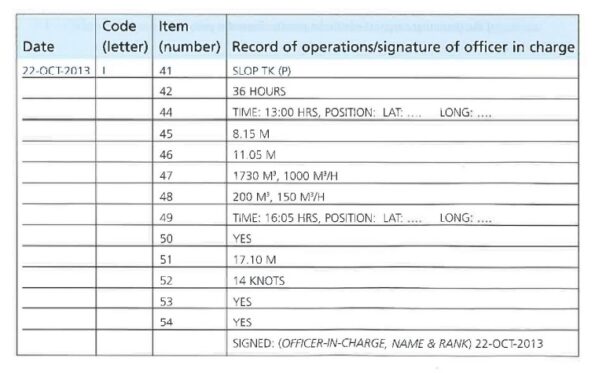
Entry Architecture & Key Requirements from INTERTANKO:
1. ORB Part I — Machinery Space Operations:
- Code C (Collection and Disposal of Oil Residues): Weekly inventory soundings of sludge tanks (Item 11.1), incinerator burning operations (Item 11.2), water drainage/evaporation, and shoreside reception transfers (Item 11.4).
- Code D (Bilge Water Discharges): Overboard discharge through the 15 ppm Oily Water Separator (OWS) logging starting/stopping GPS positions, vessel steaming speed, and continuous 15 ppm monitor performance.
- Code H (Bunkering Operations): Loading heavy fuel oil, marine diesel oil, and lubricating oils recording tank designations, density, loaded volume, and sulfur content.
- Code I (Miscellaneous Operations): Manual bilge transfers, cleaning of bilge wells, calibration of oil content meters, and accidental or emergency discharge records.
2. ORB Part II — Cargo/Ballast Operations on Oil Tankers:
- Loading, Internal Transfer & Discharge: Logging manifold operational milestones, cargo segregation transfers, and complete pump-out records.
- Crude Oil Washing (COW): Recording pre-arrival washing sequences, oil wash cycles, and machine operating pressures under the approved COW manual.
- ODME Overboard Discharges: Ballast decanting monitored via the Oil Discharge Monitoring and Control System, enforcing the instantaneous rate limit of 30 liters per nautical mile.
- Slop Tank Management: Settling oily mixtures, measuring oil/water interfaces with sonic gauging tapes, and transferring decanted water to sea.
Download INTERTANKO Oil Record Book Guides
Access the complete digital editions of the INTERTANKO practical guidelines for Part I (Machinery Spaces) and Part II (Cargo/Ballast Operations) in PDF format:
Part I (All Ships)
Guide to Correct Entries in ORB — Part I
Part II (Oil Tankers)
Guide to Correct Entries in ORB — Part II